Up to your waist in mackerel

‘Feck. Did you know once, once there was a man who set himself the task of counting the stripes on a mackerel’s back.’

---_0230

We both drank at our pints.

‘Jimmy Carroll he told me the story and showed me the paper this man wrote. His grandfather, James Carroll, was a fish merchant in Kinsale on Fisher Street and he had a shop on The Pier, and the man wrote to him letters asking questions about the fish that he sold. The man, Walter Garstang, if there is such a name was a professor and a fellow of some sort, a college, in Oxford.

‘Back then the men would catch mackerel by dropping rocks in the water. They’d take two boats out and one of those boats would have a net in and the other would be filled with pieces of stone and there would be six men in each boat . There’d have so much in the boat with the stones if they’d caught a bad wave they’d be over and down and the boat would only move slowly through the water. But they’d get it out there and they would sit there on the water and wait to see if the surface was moving and that would tell them if there were fish underneath.’
244

‘Patrick Daly he said that it was the colour of water that told you if there were fish there. He said that if the water was yellow and smelt of shit there would be plenty to catch. Michael Arundel said that if there was a smell in the air then that was because Patrick Daly was wearing the same old clothes he’d been wearing all month and that if he were to fall in the water and wash some of the shit off him there would be nothing to smell at all.’

‘The first boat once they saw some movement in the water they would throw out the net and let it sink near where they thought the fish should be. But if you let a net just hang there in the water it will catch feck all so once it was down and secure to the first boat then the men in the second boat would start throwing in their stones. You’d think that the fish would just swim away. Well maybe some of them did but there would be enough that would panic and they’d get caught in the net. Some of the men would shout at the water as well and on a quiet day you could hear them out there they would make such a noise.’

‘Once all the stones were gone the boats would pull up next to each other and then men would clamber out some so there was ten of them in the first boat and they would start to haul it in.’

‘A net like that is heavy enough when it is wet but you fill it with fish and you would need a good ten strong men to pull it in and as the fish came out they would let them fall about their feet in the bottom of the boat. They would have to climb from boat to boat as the fish came in so there were mackerel and men equal in each boat. If they had a good day the fish would be so deep they would be up to their waists here and they would have to sit on their benches as if they were in a bath of mackerel to row the boats back in.’

‘Back here their feet on the ground their boots and trousers would shine in the light the colour of the fish they were so covered in their white scales and red blood and they would have to wade back in the sea to wash it off. If they left their trousers all covered like that when they dried they’d be as hard as a piece of wood.’

‘The man, the professor he had heard that you could tell a male fish from a female by the number of their stripes. Feck I have never heard something so stupid. If you have the fish there in your hand they all look the same and if they are male and female is there any difference to the taste. How the feck do you tell if the fish you have there in your hand is a man or woman.’

He paused and as he allowed that thought to settle we both started to smile and the man made a noise his throat.

‘Feck. Can you imagine it we go out there to start sexing the feckin fish. Start counting their black lines and they’ll have us throwing them back if we get it wrong, if we miscount on the stripes on a mackerel.’

‘But this man, the professor, Garstang, he had these fish sent from all over not just from Kinsale. The fish there from Kinsale, almost 400 there were and they were fresh and they were wrapped up in newsparer, old copies of The Southern Star, but there were others that came from America and they were kept on blokes of ice and France as well. And they all went to him by boat. Now a mackerel’s no good after it has been out of the water a few hours so can you imagine them after there few days in a boat.  Think on the smell. Feck, all those fish together. He said in his paper he had almost 2,000 of them in all. Can you see it now 2,000 mackerel all out of the water and starting to smell and their insides going black. Feck you put him on one of those boats were they threw out the stones and the feckin’ fish would be jumping, jumping out of the water to be in the boat with him.’

‘Well he counted the mackerel’s stripes, he counted them and he measured the feckin things and do know what he found. He found that they all have the same feckin’ stripes  be they a man or a feckin’ woman. He would have been sick of mackerel after that. Do you think he ever ate one again.’

‘What was that question? How to kill a mackerel? I tell you, I tell you, you hit it on the back of the head with a feckin’ great stick. Hit it clean and that’ll do it. There’ll be blood and shit and their white scales on your hands and their tails will still thump at the boat but it’ll be dead and you can throw your line and your hooks back in to catch another.’

14

Outside it was coming to the end of the summer. It was getting dark and with the clear sky a chill was starting to form in the air. I could see Owen Island across the bay and there were two Great Black Backed Gulls sat on the lamps on the pier. The water was still in the early evening and under its surface the mackerel churned and turned. What sound did they make there in the water? Would they have heard the shouts of the men dropping in their stones?

I said goodnight to the man and he shook my hand. ‘You be good now’ he said.

It was a two minute walk back to The Cottage. Outside I could hear the noisy squabbling of the gulls crossing back and forth across the water. Before going back into The Cottage I turned right and walked up the pier. We’d be gone soon but the boats and and the gulls would remain and the mackerel would be back next summer and some of them would be caught up short by the hook at the end of my line. There were sprats in the water flitting just under the surface small flashes of light. Some of them appeared translucent and others carried hints of the pinks, blues and green that move over the belly of a mackerel just after it has been caught.

I turned and walked quietly back to The Cottage.

_9A_0346

The Orchard

DSCN1384

‘Now I will tell you something you don’t know.”

“Before she sold off The Cottage, Rachel Leigh-White she owned The Butter House as well and they were all one property and the orchard across the road that was more part of The Butter House and not The Cottage. The man Gould he managed to persuade her to sell him the the orachard as well and that gave him the garage and a woodshed and somewhere to park your cars.’

198

‘It was Rachel Leigh-White who planted the apple trees there. She had one of the gardeners come over from the big house in Bantry. They were started off there and he brought them over and the five trees were laid out in a neat row.’

‘But it was the man Gould and his wife who loved those trees. I don’t know maybe they didn’t have apples when he worked at his bank in India but he would make sure they were back here every year in September so they could have the best of them. Some of the apples they are good enough to eat as they are and others yoo can cook with them.’

‘Gould’s wife, she was a great baker and if you were working on the pier and she was in the kitchen the smell would be there coming out of that corner window. They would send their children up the road to where the church and the school is with bowls from the kitchen to pick blackberries. The children would come back with their faces and hands all black with the juice but they would have enough left over in the bowl for her to cook with.’

DSCN1388

‘Mary can you rember her name. He was called Terry but I can’t remember her name.’

‘Now this is what I was going to tell you. You remember Curly O’Brian. Of course you do. He died a few years back but he used to work around the garden and mow the lawn. You gave him a lift home sometimes in the evening when it got too far for him to walk back into the hills from here.’

‘Before Gould sold the place he would say that one of the things he would miss most would be the eating the apples come autum. So for a few yeasrs after you bought it Curly O’Brien would be asked to pick some of those apples and wrap then in paper and send them to him back in England. Curly would get a letter and some notes to pay for the postage and his time. But then one year there was no letter and that was the end of the arrangement.’

Back in The Cottage I went to the shelves by the cupboard under the stairs and took down The Cottage Log that Terry Gould had left behind after we bought it. In it he had made a note of useful telephone numbers, guidance on the intricacies of the plumbing and the pump. On one of the pages he had made a note of the apple trees in the orchard.

 1st nearest road Bramly late Oct on. Hard cooker. Very good flavour- good keeper.                                                                                                                                                                                 

2nd furthest from road Grenadier August. Soft golden yellow cooker. Almond flavour.

3rd furthest from road Worcester Pearmain (?) heavey cropper September. Good eater especially eaten straight from the tree.

4th furthest:  Elstan, younger tree. September/Oct very crisp eater.

5th furthest: Cox’s Grange Pippin October – fine eater

Roast hake steak with potato and tomato

I cooked supper for myself this evening. The rest of the family voted against anything more exotic than fish and chips. So I did that for them and for myself bought a hake steak from Wards.

I can’t remember where the recipe comes from and if I had it first in The Good Thing’s Cafe but it is one that always goes well. It works best with an old battered terracotta dish – ideally from Spain.

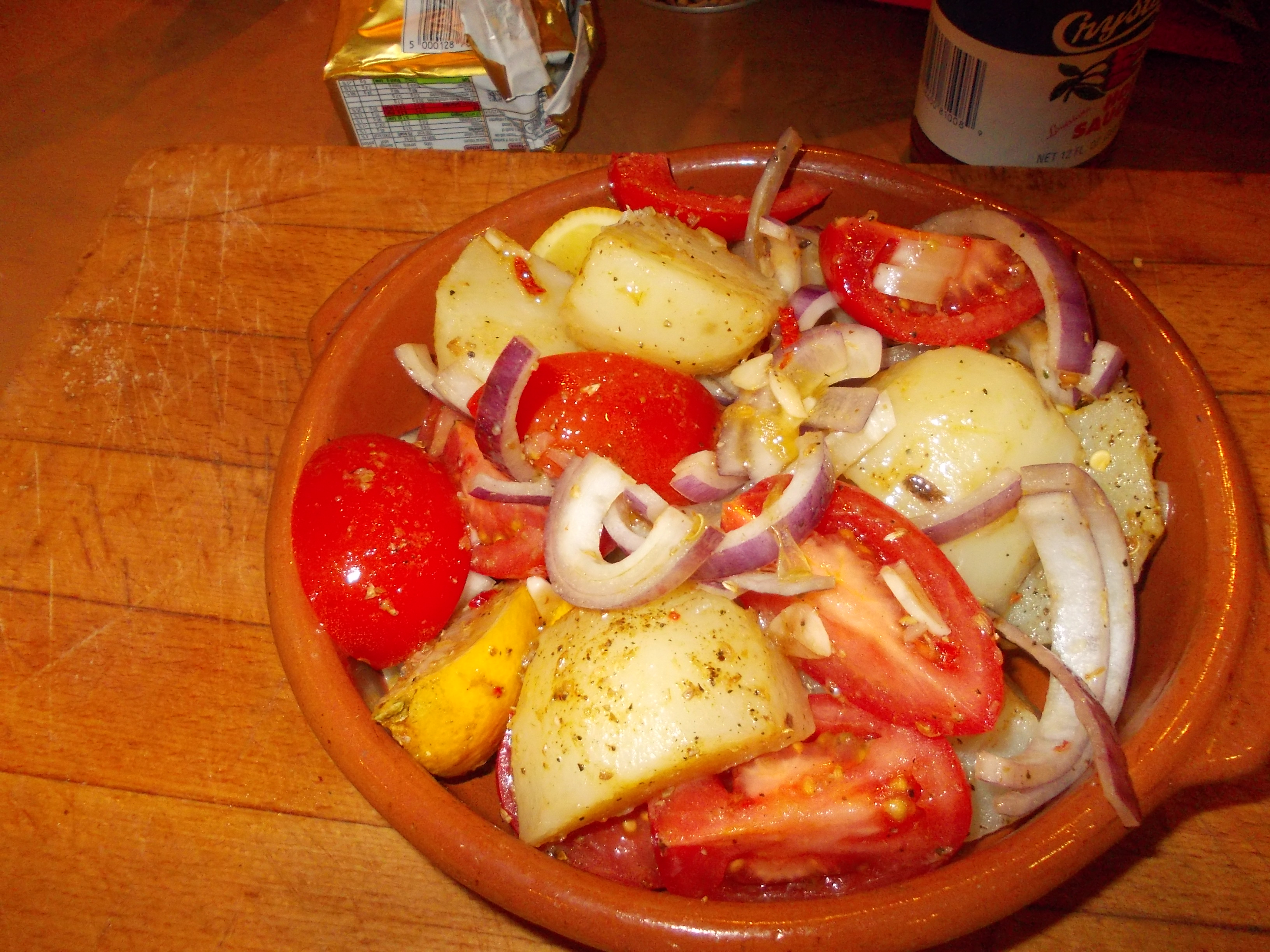
Peel and boil a couple of medium sized potatoes. While they are cooking quarter three good tomatoes, slice a red onion, squash a couple of cloves of garlic and slice up some chilli. Put all this in a bowl together with a quartered lemon. When the potatoes are just cooked drain and quarter them and put them with everything else. Pour over a good few glugs of olive oil, season with salt and pepper and some ground cumin and coriander. Stir well together.

DSCN3880

The oven now needs to be hot. Put in the dish to warm up. When it is hot take out to pour in the potato and tomato mix. Put in the oven to cook for about 8 minutes. Season your hake steak and put this on top of the dish and put it back in the oven. It should done in about ten minutes. Sprinkle over some finely chopped parsley and eat.

DSCN3881

The greengrocers this morning

DSCN3878

In the greengrocers this morning Kazim asked me how was my work. I muttered an uncommitted reply.

‘I have the best job’, he said, ‘and one of the oldest. I’m here all all day and I talk to to everybody. There are so many people and they come here and they buy their food. Always  there are people and they have to buy food and when you buy food you will have something to say. Mostly it is something simple. Something about the weather or where they have parked the car. And you know that is good. I will say something back and over a  few minutes we will talk. And then sometimes there will be someone here who wants to talk. And you know then I will listen.’

‘I stand here behind the till and I am in charge. I have been out in the morning to the market and I buy all this and over the day it has to be sold. But I can sell it.’

‘And you know tomorrow I have to play football. There is a team that plays down by Arrowe Park and I play for them. I go out on a Sunday but I can’t move for a few days after.’

‘You must be too old for that’

‘No I have to do it.’

As he talked I could see a Chinese woman outside. She was pulling the leaves off a green vegetable on one of the trays. Kazim saw her as well and said “Excuse me’ and he went out to talk to her.

He was back a few minutes later with a wooden tray full of the green leaves.

‘I told her you can eat the leaves’ he said, ‘ but she didn’t want them. Look.’ He tore a corner of leaves and put it in mouth.

‘What is it?’ I asked.

‘Koulabrai,’ he said ‘It’s a bit like a salad. You try some.’ He tore off another piece, about an inch square. It tasted fresh and green with a hint of mustard.

‘I cooked some of it last week with a stuffing. It was rice and hard yellow peas partially cooked, mixed with some herbs, parsley and dill, and a spice mix and some tumeric. I rolled them up like this.’ He rolled one of the large leaves around his finger.’ And then I put them in a pan with some water. I boiled the water until they were done. You had to be careful the pan did not boil dry so put some more water in if you need to then leave some in the pan when they are done. They are good.’

‘Here you take some of the leaves and try them at home.’ He took a large hand full of the leaves and put them in bag which he put in my basket. “You have them’ he said.

The Chinese woman was in the shop now. She walked up to us holding what looked like a knobly cucumber. “How much is this?’

Kazim went off to serve her. Once she was done he took me over to the fridge. “You should try these’ he said picking up one of the knobly cucumbers from a tray. ‘They are bitter gourds. I know that you like to experiment with your food. So you should try one of these. they are bitter but not too bad. I have them in a stir fry or I chop up some and put iit in a salad. You should try it.’

So I took one and I’ll try it this evening.