My first bag of mackerel

Ever since they were banned plastic shopping bags have acquired a particular value especially round the pier. They are the perfect vehicle for passing on fish, prawns and lobsters but they are not so readily available as they once were, so old bags get kept to be passed on again and again developing an ever higher old fish smell as they go.

My first bag of mackerel was passed on to me by Curly O’Brian.

Curly was tall and pale and he was somewhere between 60 and 70 yrs old. His hands and body was beaten back by the weather and although he was a big man there was a lightness about him. As he shook my hand he would lean into me and his hand was hard and heavy in my mine. There was nothing tight there but the weight of him bore down in the greeting.

He had a thick accent and his words would mash together leaving me trying to piece together what he was saying by reference to what was around us and what he might have been talking about be it the weather, the Cottage’s porous boundaries, fish coming in from the sea and whatever else might have taken his fancy.

It was the first or second summer we spent time in The Cottage. We had arrived late at night as the festival that takes place over the first Bank Holiday weekend was in full swing. We lay in bed awake listening to the band and the laughter coming down from the back of Arundel’s.

Over the next few days we were bewildered by the activity, the number of people on the pier and the sound of a local radio station blaring out until late at night from speakers strung along the lamps on the pier.

On the Monday afternoon it was the fishing competetion. There were no boats at The Cottage then and we had not yet been out to catch mackerel. I was down on the pier watching the boats come in and the men lifting out their crates of mackerel to be counted and weighed. There were shouts for the biggest and best.

As I walked up and down the pier I bumped into Curly. Rather to my surprise he recognised me and he took up my hand to shake it. We fell in to talking and I had to lift my head at an angle as if being able to hear better would make his words clearer.

I realised we were talking about mackerel and so I shook my head and said we had not been out fishing.

I have some mackerel I caught in his voice will you have some.

I was polite in reply ‘Only if you have some to spare.’

He laughed feck come with me the words mashing together there’s too many of the feckin’ fish here.

He walked me back down the pier and we crossed over the road to The Butter House. There was a shed on the right hand side next to the stream that runs down by the pier. Curly pushed open the door as if it was all his and reached in to pull out a battered steel bucket full of mackerel.

With the bucket on the floor between us he pulled out of his pocket a plastic bag and bent down to start picking out the fish. His hands were big enough almost to cover a fish whole. I think he would have given me the bucket if I had not stopped him. There were seven fish in the bag that he passed over to me.

I shook his hand again to to thank him and it was still wet with the fish.

We had three of them that evening roasted in the oven with garlic and cumin.

The next day it was wet and cold and in the evening we lit the fire. I wrapped two more of the fish in bags of foil and cooked them on the fire.

I last saw Curly when he stopped in the garden one evening as we were down on the beach. He’d been in the pub and it was getting late and he was wondering if we might be able to give him a lift back to his farm in the hills. He pulled up a chair just behind us and settled himself down as we finished our food. We were not to worry about him and he would sit out the evening until we were ready for him.

He had to bend carefully into my car and I took him back home. I am not sure now I could find myself back to his farm in the hills.

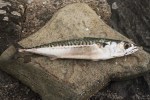
How to kill a mackerel – essential equipment

I have been doing this for a year now – the anniversary passed sometime towards the end of last week. There have been almost 300 posts and about 10,000 views in total. I hope that those who are still reading get some enjoyment out what sometimes feels like a stream of non connected nonsense that I put down on this white screen.

The good news is that somewhere in the background the book about mackerel is taking on a different shape and I am working on ways to get the man with a black beard in there. The difficulty is that I know who he is and what he is saying but will someone get him if they pick the book up cold. Maybe I will have to give him a name.

Anyway looking through my latest new cookbook – Josh Sutton’s The Guyrope Gourmet I realised that what the book about mackerel is missing is an equipment list for both out and in side the kitchen. So here goes – starting with the outside:-

A boat – suitable for catching mackerel from. It can by a kayak, a robust dingy or something more substantial. The important thing is that it should have the means, be it oars or a paddle or an engine that works, to get you and your line to where the mackerel swim.

A pier or rock – in the absence of a boat you can occasionally catch mackerel from the shore. I have only seen one mackerel caught on a line from the end of the pier. But then one year I managed to catch some from the slipway. The tide was high and the fish had come in right up close to the wall under The Butter House chasing sprat and they bit easily at the hooks I dangled in the water. But that was luck. Otherwise you need to know your spot and be there at the right time of day, when the tide is right, for when they come in close enough to shore to be caught.

A line – this has been described elsewhere. They are easily bought close to the coast. It is always worth having an extra line just in case the first gets ‘lost’ and some spare feathers and lead weights. If the mackerel aren’t biting then a new set of feathers may make the difference although rusty hooks and bedraggled feathers have worked just as well as shiny new ones.

A vague notion of where to fish for them.

The priest – something to knocked them dead. A piece of wood is good. There needs to be some weight to it so that a quick sharp tap at the back of the head gets them right.

A sharp knife – sharp enough so that it will nick a slice off the top of your finger if you try to play air guitar with it. It should have a good point on it as well to start at the gutting.

A flat stone – to lay the fish on as you fillet them.

Gulls – to screech and yawk back their heads and to fight over the guts and the heads.

A beach – with stones to make up a fire and driftwood for fuel.

Pub – to supply pints for when you come back to the pier successful with a bucket of mackerel and then to fortify you as you bloody hands down by the rocks.

In the kitchen it is worth having to hand those things that go well with mackerel. They are oily fish and need something sharp to cut through that so; lemons, garlic, paprika, cumin, coriander/parsley, rhubarb/gooseberries.

If I am going to fry them then some olive oil or butter is good.

Bread or potatoes to eat with them.

And not forgetting another pint or two to wash them down.

Out catching mackerel

The place and time to do the fishing is the difficult thing. There is the point off Owen Island where the fish seem to channel in a line that crosses the opening into the main part of Dunmannus Bay and then along the seaward run of the Island about a hundred yards out. The time is the late afternoon on the cusp of the high tide. Stop the boat on the western side of the opening and allow the wind and tide to drag you eastward down the bay. If the fish are catching then you can move a surprising distance in a short space of time. Watch out for the rocks and keep the engine ready for a quick start if you are drifting too close. Within sight of the Cottage the point is a 10 minute ride from the pier. There is great satisfaction hauling in the fish ready for supper that evening.

Although the point maybe the best place in easy reach of the Cottage I have been there when all seems perfect and come back with an empty boat and we have had to conjure up some other food for the evening. There are those occasional weeks in August when the fish don’t bite and it seems that they have returned to the deep water.

Once you have picked the spot turn off the engine or haul in the hours. Let the boat drift for a few seconds so that it finds its place against the wind and the position of the tide. Take up one of the lines and hold it up in the air with the weight hanging down. It is best to do this in the boat slowly unraveling it so so the hooks swing loose. One or two of the hooks will catch either against themselves or one the orange twine and you will need to use quick fingers to tease them free. Once the hooks are hanging loose throw the weight and the line over the side of the boat and quickly unfurl the line. There is no science to how much needs to be let out. They could be biting a few feet under the surface or they maybe in the deeper parts of the channel.

Let the line run through fingers and when it feels right stop. Hold the line tight and sit back and enjoy the view. At that point off Owen Island you can see the whole sweep of the bay starting to open up to the Atlantic. To the South there will be the rising peak of the Mizen, Knocknamadree and beyond that Three Castle Head. Five miles across the other side of the bay The Sheep’s Head tapers away into the sea. Between the two points is the milky white line of the horizon drawing the eye in where forever the sky merges with the sea.

Having admired the view tug at the line. Unless you have been lucky it will feel slack in the water with the vague pull of the weight. Pull the line back up quickly through you hands dropping it into the bottom of the boat until you can see the hooks just about to break the surface and then let it go again. With the line loose it should fall more quickly now. Take a hold of the line every few seconds to pull it up short before letting it go again. Once it has all gone repeat the process. As the boat drifts slowly the line will be held back by the weight streaming behind the boat. Your hands and clothes will be wet from the water that spins off the line as it passes to and fro.

The important thing is always to keep a tight hold of the line because once the fish do take hold they will pull it in before there is time to grab hold of the wooden frame. If I remember I wrap it a few times round my ankle leaving both hands free should I need them.

And there you have it. All we do is jig with feathers and wait for the fish to bite.

As you are pulling the line you may feel a shudder. Give it a good jerk so that the hook catches and haul the line in quickly. If you stop too long that may give the fish a chance to swim loose from the hook and escape. If it is just one fish the line will cut through the water following the line of the fish as it tries to swim against the tug to the surface. If it is two or more fish the line will vibrate as the fish pull against each other trying to get away.

As the hooks start to break the surface lean out slightly so as be able to pull the fish free of the water and swing it into the bottom of the boat. One fish is normally straightforward to deal with. More than two and it gets exciting.

The first thing to do is remove the hook. Take the fish up tight in the left hand. You need to be firm about this. The fish is still very alive and will be beating hard to get away but provided you grip it tightly it won’t slip away. Once it is in your grasp hold it up so you can see how the hook is caught and try to ease it out of the mouth without tearing too much.

If a lot of fish have come into the boat you will want to try and unhook them all first before dispatching them. If the fish are left on the line for more than few moments their twisting and turning will tangle the hooks and then next twenty minutes will be spent sorting it out. Once the fish are unhooked the easiest thing to do with the line is to throw it back in the water to clear space in the boat. Bear in mind that if you have just hauled in a few fish that means they are thick in the water and you may find that some more are caught almost as soon as the line hits the water.

To dispatch the fish take it again in the left hand and hold it steady against a hard surface in the boat and tap it hard at the back of its head. It will still thump and kick after that but it will be dead. Put that one in the bucket whilst you deal with the rest.

If the mackerel are thick then there may not even be the need to move the feathers through the water. As you throw the line in you can feel it shudder as they bite and you can be hauling them back into the bottom of the boat straight away.

If you are allowing the boat to drift with the tide you may find that after a ten-minute furious spell with not being able to keep up with the fish as they are caught all goes quiet. It may then be a matter of putting the engine back on and trying to position the boat back to where the fury began so as to find the fish again.

Making do with Red Gunard

My heart had been set on Red Mullet this morning when I went to Wards. Lying in bed before getting up I had fixed them on the barbeque cooking with some fennel and pine nuts and then eaten with a couple of salads.

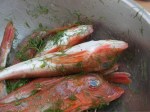
But when I got there there was no Red Mullet. In their place they had a large plastic tray of Red Gunard. They’d had to take the small ones along with the larger ones. The tray was behind the counter and Simon let me come round to help myself. They were gloriously slippy and wet as if they had just come out of the sea. There was a temptation to fill a bag  full but I was only feeding the family and I knew that not more than a few would be eaten.

In the grocers I told Nadir that I had bought some fish for the barbeque that evening. We were both looking forward to spending time out in the sun.

He told me that one of those meals that he could remember was grilled fish with a sauce. His family had taken a three storey house in Turkey and they were all there with his brothers coming from Germany and Iran. His mother had cooked small fish on the grill and she had made a sauce to go with with them.

I asked him if he could remember how she had made the sauce.

He couldn’t. She had made it and that was enough and the memory of how it tasted was with him and brothers still and they always remembered the sauce.

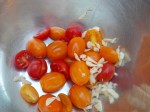
Before we ate from the barbeque I made a bowl of gazpacho – two bags of tomatoes from the grocers, two sweet green peppers, half a peeled cucumber, onion, olive oil, garlic (and more garlic), salt, pepper and a couple of slices of dried bread. It all went into the Magimix and was sieved before it went into the fridge to cool.

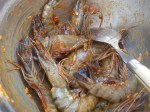
We also had some prawns in paprika and a squid marinaded in chilli, lemon juice and olive oil before being flash grilled.

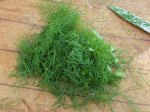
I cooked the Gunard in fennel. As I took the fronds in my hand the smell of it took me back to the patch of ground behind the Cottage next to the pier where the fennel grows wild and salty from the sea.

We ate it all listening to Rod Stewart and The Faces.