Pumpernickel and smelly feet

To my surprise I have not been able to find much that has been written on pumpernickel. I half thought that Elizabeth David would have a few good paragraphs in her book on bread cookery or that there would be a section devoted to it in Alan Davidson’s  Oxford Companion to Food. But there was nothing to be found.

Then I remembered that the Wikipedia article I found explaining the relationship between pumpernickel and flatulence also made reference to the Dutch version of the bread roggebrood. I have a book on Dutch baking called Windmills in my oven and in it there is a whole three pages on roggebrood. 

The book sets out to uncover the hidden history and tradition of Dutch baking and expose it to the world in all its glory – so there are chapters on pancakes and speculass, stroopwafels and a type of Dutch sweet coiled sugared bread that goes by the nickname of droppen on account of its unfortunate but unmistakable resemblance to a turd.

The section on roggebrood explains that for many people then it was seen as only being fit for feeding to livestock and that sometimes the quality of rye was so poor that it brought on a case of sand colic to anyone who tried to eat it.

It goes on to explain how the dough would be kneaded in great wooden troughs, though ‘treaded’ would be a better more accurate. The first dough-kneader was invented in 1603, expressly for avoiding foot contact and thereby rendering it more palatable in the inventor’s view, but it wasn’t until the beginning of the twentieth century that machines -dog, horse and petrol driven – gained popularity, especially in rural areas. Using feet was the easiest way to knead the heavy dough efficiently, making full use of one’s weight. The modern mind finds this distasteful; not so the customers of old. As one former baker recounts, a customer complained at the beginning that the bread had a machine taste, whereupon the baker tartly rejoined that at least the sweaty foot aroma was gone. Admittedly, both body temperature and physical contact have a beneficial effect on dough…..

Which all perhaps begs the question as to which of the seven were treaded as opposed to kneaded?
OLYMPUS DIGITAL CAMERA

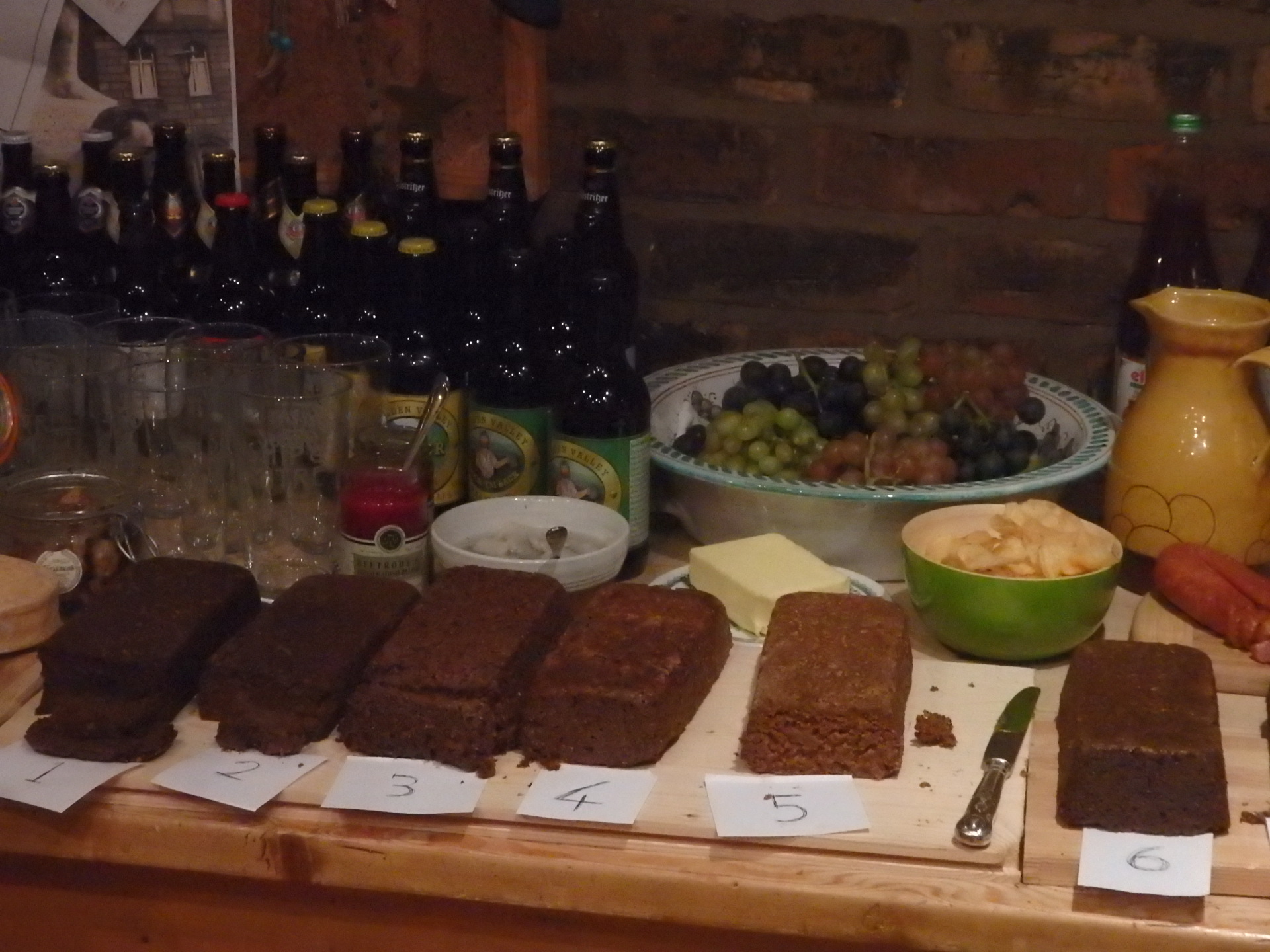
Pumpernickel – a gathering of old farts!

We ate pumpernickel last night and one or two questions were asked as to the meaning of the word.

So when in doubt turn to Wikipedia!

The philologist Johann Christoph Adelung states that the word has an origin in the Germanic vernacular where pumpern was a New High German synonym for being flatulent, and Nickel was a form of the name Nicholas, commonly associated with a goblin or devil (e.g. “Old Nick”, a familiar name for Satan), or more generally for a malevolent spirit or demon. Hence, pumpernickel is described as the “devil’s fart”, a definition accepted by the Stopes International Language Database, the publisher Random House, and by some English language dictionaries, including the Merriam-Webster Dictionary. The American Heritage Dictionary adds “so named from being hard to digest”. A variant of this explanation is also given by the German etymological dictionary “Kluge” that says the word pumpernickel is older than its usage for the particular type of bread, and may have been used as a mocking name for a person of unrefined manners (“farting nick”) first. The change of meaning may have been caused by its use as a mocking expression for the (in the eyes of outsiders) unrefined rye bread produced by the Westphalian population.

The OED does not commit to any particular etymology for the word. It suggests it may mean a lout or booby, but also says “origin uncertain”. The OED currently states the first use in English was in 1756.

A false folk etymology involves Napoleon, who, while invading Germany, asked for bread and was served dark Westphalian rye bread. According to the folktale, Napoleon declared that this was not suitable bread for himself, the emperor, but was bread (pain) for Nickel (or Nicole), his horse: “C’est du pain pour Nickel/Nicole!” In a variation of the same basic story, Napoleon declared that the bread was no good for him, but was only good (bon) for his horse: “C’est bon pour Nickel!” The name “Nickel” is not confirmed for any of Napoleon’s many horses, still, given the number of horses used, this remains a possibility. This folk etymology grew from a “witty interpretation”, proposed by seventeenth-century satirist  Johann Balthasar Schupp, that the bread was only good for “Nicol”, a nickname for a weak or puny horse. It is not clear why anyone imagines that the Germans would name a much loved local speciality after an insult in a language they did not understand.

OLYMPUS DIGITAL CAMERA

Is there a word to describe a gathering of pumpernickels? Would trump cover it?

Anyway they were mighty fine. As was the beer, cheese and sausage.

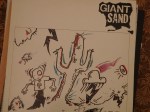
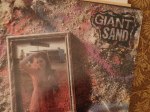
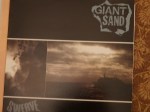
Mexican tinga poblana and Giant Sand

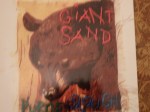
Ok. If the best night of my life was when I saw REM at Warwick University in about 1983 and Green and Red played at about 2.00 in the morning and I was at the front doing the Woo Woo’s into the microphone that was thrust into the audience as they covered Sympathy for the Devil and Pete Buck played guitar and ignored me when I told him I loved him then the second best was seeing Giant Sand in the Co-operative Hall on the Cowley Road only a few years later.

Giant Sand are one of those bands.

They have been releasing records for more than thirty years one way or other either under the name of Giant Sand or under cover of main man, Howe Gelb, or one of his aliases. There is a sound to all of them – an out of kilter sun blasted sound, stuttering guitar and Howe Gelb’s half singing half talking voice over the top – telling of another shagged dog story. He’s made records with Canadian choirs and Andalusian guitarists and most recently a motley crew of Danes and although each are different they are all anchored down by his voice and the sound.

For the second best night we started the evening off in The Bullingdon Arms drinking Guinness with whiskey chasers  and then made our way to the gig. The evening passed in a blur of Newcastle Brown Ale, all that was sold in the venue, and music. For part of the gig Giant Sand were joined on stage by some old timer singer in a black cowboy hat, black leather and a silver eagle belt.

I shouted out for them to play Mountain of Love and although Howe said it was an old one he played it and we danced furiously at the front of the stage and Howe handed me a can of beer to finish off in the heat.

The next day I was walking into Oxford across Magdelen Bridge and Howe Geb was sat on one of the benches looking cool in the sun shine. I was that close to going up and thanking him for the beer but I carried on. He just looked too cool and of himself to be disturbed by me. But I still think that if I had gone up and said hello then my life would have turned out differently.

This evening we have eaten Mexican tinga poblana, which seemed appropriate. The recipe came from Diane Henry’s Food from plenty.

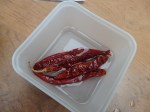
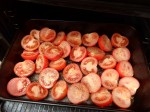
A kilo of good tomatoes were halved and roasted in a hot oven with oil, salt, pepper and sugar for forty-five minutes and four dried chillies were put to soak in warm water.

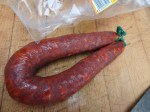
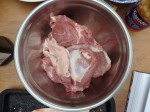
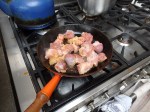
A chorizo sausage was cut up and cooked in oil until it started to give off its fat. In then went a large oven proof dish and a half shoulder of pork which had been chopped down to manageable chunks was browned off in batches in the same pan. As each batch of pork browned it went into the pot with the chorizo. Once the pork was done some oil was added to the pan and a couple of onions were browned off as well with garlic and chopped marjoram from the garden and ground cumin. The pan was cleaned out with some beer and the pot then went on a low heat for an hour or so.

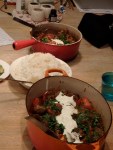
Twenty or minutes or so before we were due to eat the tomatoes were spooned into the pot and stirred in so they just about held their shape. I should have seeded the chilies but they didn’t seem hot enough so they were chopped and added along with the liquor in which they had been soaking.

For eating it was covered in chopped coriander and soured cream. We ate it with rice listening to burnt out music.

A cheese fondue

OLYMPUS DIGITAL CAMERA

There is a danger that Spring may be round the corner. One of us was outside sweeping up the end of last years leaves and the other was inside feckling out bits of dust that had been sat quiet for too long.

The leaves are all bagged up and hopefully this time next year will have turned into a dark brown mulch that I will be able to spread around elsewhere in the garden.

In the sun the greenhouse was hot and I felt a twinge of guilt that I hadn’t got round to planting anything in there yet. If I had done then the seeds could of been making good use of the heat.

The guilt was assuaged by the fact that I had been able to extract a confession from someone whose tomatoes I have long admired that he didn’t grow them from seed but instead he picked up seedlings from the garden centre instead.

There was one solitary squashed looking daisy in the middle of the lawn but a couple of daffodils had blown cover and there was the first sign of blossom in the trees.

OLYMPUS DIGITAL CAMERA

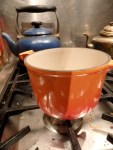
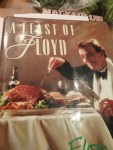
As a last hurrah for the cold months we had a cheese fondue recipe courtesy of Keith Floyd.

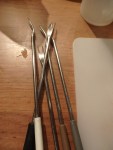
It is perhaps difficult to believe the we are blest with having two fondue sets.

I had acquired one as a Christmas present a year or before getting married and then we got the second as a wedding present. hey don’t come out very often although I do have dim recollections of being bold enough to have two different cheese fondues on the go on the one evening. There must of been a few cheese nightmares that night.

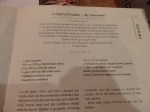
If we do have a cheese fondue then it is the Keith Floyd recipe that I use. An almost equal amount of amount of Emmenthal and Gruyere cheese cut up into cubes stirred over a low heat in the fondue pot with wine, a squeeze of lemon juice and a dash of Kirsch mixed up with some cornflour. The cornflour is important as it helps bind the wine a cheese together in a smooth creamy mass.

Don’t forget to rub the inside of the pot with some garlic before you start cooking.

Once the cheese has melted and blending into wine and volcanic bubbles are bursting through the surface, stir in some chop herbs and salt and plenty of pepper, then transfer the pot to the burner and eat with crusty bread and try not to burn your mouth.