A walk up Rosskerrig

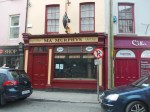
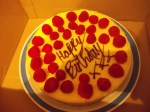
We celebrated a 17th birthday Tuesday night in the top room in Arundel’s Pub.

It had rained heavily during the afternoon but the skies had cleared by the time we walked up there leaving the ground slick with wet.

It wasn’t a late night and as we parted Hugh and I arranged to meet at 8.30 the following morning at the crossroads by the bridge over Ahakista Stream for a walk to the top of Rosskerrig. In the clear evening sky we told ourselves that it would be good day for walking.

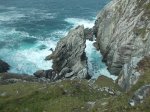
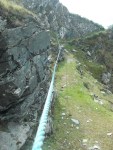
It was windy but dry when we met up and started on up the road up the hill behind Ahakista. This was the old Mass Road. There are no churches on the north side of the Sheep’s Head so those living in its few scattered houses and farms would to cross over the spine of the peninsula to attend the church in Ahakista to celebrate mass. The path crosses over through one of the low pinches of the central ridge.

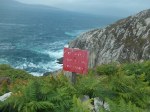
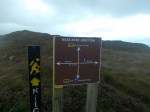
Most of the walk up was easy going on a tarmac road, it was only as we got almost towards the ridge that the road fizzled out and we had to follow the signs taking us to the top.

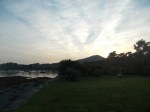
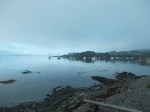
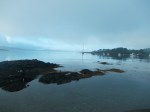
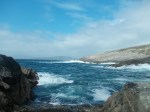
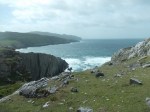
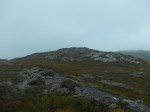
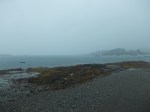
At the top we could just about see through the cloud hanging over Bantry Bay to the mountains on the Beara. Behind us and to the south the air was clearer and we could see back down the bay towards Durrus. For a while the sun came out over the bay silvering the water.

We continued to walk along the ridge of the peninsula – Bantry Bay to the right Dunmannues Bay to the left. We paused every so often to take in the air and the view.

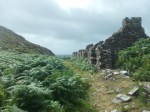
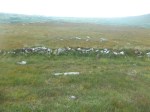
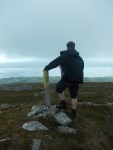
At the top we could see through the bracken the marks of old walls from when people had tried to scratch a living out of the rough ground. There was even the layout of what could have been an old shelter of some sort – a large headstone and at right angles to it a row of four five flat stones.

The wind started to bear down on us at the top. It was coming from the south and every time we got into the lee of the hill on the north side there was a small relief from it bearing down.

Heads down making our way I saw a toad in the path. It sat there impassively waiting for us to pass.

As we came down from Rosskerrig the cloud start to lower and we felt the first few specks of rain that was to last for the best part of the rest of the day.

On the hill it hit us hard in the face stinging our cheeks and it was only when we were through the steep creases in the valley, up and down, that it started to soften.

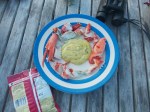
Two and an half hours after the walk started Hugh fed me bacon and black-pudding .


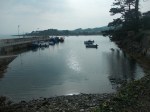
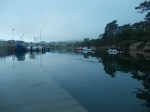
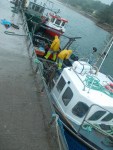
The rain hardly stopped all day. Back at the Cottage I watched the fishing boats come in to the pier. Out on the water there was a grey wall of cloud and the water was churned into a mass of white horses.

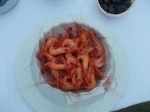
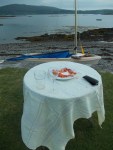
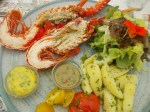
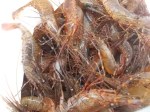
I felt guilty asking if I could buy a bag of prawns. All that hard work on the water to keep us fed with a few mouthfuls of food.


The day of the festival

‘Feck the feckin’ feck the feckin’ fecks got my finger.’

DSCN8018

The afternoon had started well but with Pat O’Mahoney’s burst of extravagant language the chairman’s heart sank .

One of the two nuns looked at her sister and shook her head sadly ‘Was that the ‘f’ word I heard in there?’

The sister had been listening carefully ‘No dear I think he managed to avoid that word he was only feckin’ the feck.’

The chairman cast his mind back over the afternoon.

Michael Noon had won the Turnip Throwing Cup, smashing all previous records, with the throw of a turnip grown by Edna O’Malley especially for the event. She claimed that a regular feed of rotten mackerel manure in the three weeks leading up to the competition gave the turnip an ability to sail through the air more quickly than turnips left to fend for themselves.

There had been some debate as to whether it was possible to extract enough manure to make it worthwhile feeding a turnip but Edna swore that she had her methods and that if you had a bucket to hand and squeezed them right as they came out of the water then a supply could be had. It was then a question of selecting the turnips for the feed. They only needed a few drops so it was no great bother.

Michael Noon put the win down to local knowledge of the hilly terrain from where he undertook the winning throw and the strength in his throwing arm to time well spent hauling in lobster pots, others whispered that it was time less well spent lifting pints that built up the muscle.

The Car Smash had gone a treat. Patrick O’Riordan had donated his old pink Mini Metro for the day and it had taken seventeen youngster, togged in goggles and helmets, to reduce it to a pile of broken and twisted metal, plastic and glass with a sledgehammer over the course of the afternoon. There were a few injuries but these had come about more from a misapplication of the sledgehammer rather than anything to do with the car. The hunt was now on for another Mini Metro that could be donated for next year’s festival.

The swim races and raft race and all passed off with no incidents. There had been acrimony in previous years with there being a suggestion that some of the youngsters were not as young as they claimed and there had been a manipulation of birthdates. There problem came to a head when two six foot lads with too much hair on their legs claimed they were eligible for the under thirteen freestyle across the bay. They had been allowed to compete but some of the smaller lads all but drowned in their wake. The Chairman’s bright idea that all competitors produce a certified copy of their passport had brought some order to the event .

A last minute replacement for the duck chase had been found and it proved to be eminently suitable keeping the competitors at bay for a good ten minutes and it was adept at getting away just has some lad was about to make a grab for its tail-feathers through the water. The winner had able to keep a hold of the duck without breaking its neck and there was general agreement that it should be kept available for next year.

There was a great deal that had been a success but now as an arc of bright blood smeared it self over the pier the chairman had to gird his loins in order to deal with the root cause Pat O’Mahoney’s burst of extravagant language

Lunch in Schull

Most summers when we go to Schull lunch is taken at the fish’n’chip shop down by the pier. Tables laid out in the sun, fish fresh from the sea and fried almost in front of you before being piled into cartons with mounds of thin chips and balanced precariously on plastic trays to be eaten with relish with a bottle of cold Muscadet drunk out of small plastic glasses.

This year the weather in Schull was grey and full of impending wet so we didn’t make past the lure of the dark interior of Hackett’s.

We were squeezed onto the end of an table by two ladies who were having a long lunch talking about seaweed courses at the Good Thing’s Cookery School and how many bales of hay one of them was able to bring in from her fields.

I had an open crab sandwich; a pile of white crab meat on top of thick chunks of brown soda bread with pint of Murphy’s to wash it down.

After lunch, buoyed up with the Murphy’s I bought myself a smart new shirt and another stylish hat.


There was a satisfactory amount of traffic blocking up Main street.

Sunday lunch at Good Things Café all the way to Alice

Ten years ago we had friends staying with us in the Cottage and some of us were celebrating our fortieth birthdays so we had at least two good long lunches at The Good Things Café.

Since then we have been back two or three times each year – normally for lunch with children and then a meal in the evening.

This year we had lunch there on Easter Sunday and we have just been back for another Sunday lunch.

It was a good day to go out for lunch; a squally wind bringing in thick wet rain that hadn’t stopped since we opened the curtains.

It was a day to spend another hour in bed reading, drinking cups of coffee and sitting around fires.

There were eleven of us eating for lunch and they had a table laid out for us by the door as we walked in. As we ate we could watch the weather outside, more wind and rain heavy enough to soak a person on the five-yard walk from the car park to the door of the café.

I had gazpacho to start, a bowl full of pale red cool soup the surface broken by a dash of olive oil – it tasted of garlic, tomatoes and the sun and was a stark contrast to the bluster and hell for leather of the weather outside. Others had the fish soup and it came to the table in two large white tureens, thick enough to stand a spoon in there were so many pieces of fish and other goodies from the sea swirling around in it.

Unfortunately there was only a limited amount of crab tart so I couldn’t have that, instead I went for an Egg Florentine with a thick slab of Gubbeen ham, layers of spinach, a poached egg and a silky slather of hollandaise sauce.

We were all stuffed but managed to find room for pudding and I had a small pot of St Emillion chocolate mousse, which is probably the same pudding I had on one of those lunches ten years ago.

It was just as good on Sunday as it would have been ten years ago.

As we drove back there was a break in the weather. It came at that part of the coast road where it turns back towards the sea and over a slight rise the whole of Dunmannus Bay is laid out open in front of you. The end of the Bay was filled with a great wall of grey cloud but over towards the hills of the Sheep’s Head the sun was trying to melt the clouds away and they were turned a bright white that then seemed to fill the air beneath them with luminous light that hung in the air in front of the grey cloud and the moutains.

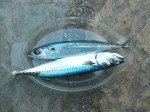
Later that afternoon I watched the fleet returning from the mackerel competition. It had stopped raining around four o’clock so they had had a couple of hours fishing out of the wet. They still looked fairly bedraggled as they came in.

I had spoken about the competition the previous evening in the pub and was reassured that it was only a bit of fun. But they took it seriously enough to make sure that each box of fish was properly counted so there could be no doubt over who had one. The winning boat had caught more than 600 fish so that was a lot of counting to do under the eager eyes of the spectators and quick hands looking to dive in and secrete a couple of fish in a plastic bag to be taken home for tea.

Willem won the competition again and he filled the cup with whiskey and passed a sip on to every man on the team.

Down on the slip way a battery of grim faced men and women took to the mackerel with sharp knives, filleting them and throw the heads and bones to an eager and raucous audience of gulls. The gulls fought over the scraps tearing at the pieces of fish and each other. After twenty minutes the gulls quietened down as if they had filled themselves with the surplus of easy fish. An hour later they bobbed on the water too fat to fly ducking their heads under the surface to clean off their beaks.

Later we walked to The Tin Pub to see what music was on. Brian and Nicole were playing but around the bar there were a few familiar faces from last time we had seen good music in there. We got out pints and other drinks and settled down.

Brian and Nicole played a couple of sets but then they took a step back and over the rest of the evening the familiar faces moved behind the microphone to sing and play a song. Instruments were swapped and passed round; there was a penny whistle and an accordion as part of the mix.

At some point in the evening Hugh was able to establish that fifteen years previously he had seen one of the woman who was singing perform in Arundel’s Bar. On that occasioned she had sung a ribald version of the old Smokie Song ‘Alice’. She reprised it for the evening and the fifty or so people crammed into the bar singing along to the chorus ‘Alice, Alice? Who the feck is Alice?’

Then there was dancing and stamping of feet and more dancing until seemed there wasn’t anyone in the bar who wasn’t going to take their turn with a guitar and the microphone.

We staggered home at 2.30 in the morning the rain coming down like a gentle mist.