On Saturday Ward’s were selling lobsters. They come in from Cornwall and are cooked before being put on display the colors bright red against the white ice and grey fish. I compare notes with Nigel over their cost. In Ahakista we buy them from Tommy Arundel on the pier. He is out in the bay in his boat Freedom most days of the week hauling in the pots, pulling out the lobsters and crabs, re-baiting and then laying the pots down again.
Last summer I spent an afternoon on his boat watching him work. It took 45 minutes from Kitchen Cove to get up past Donneen Pier and the great piece of orange cliff that had fallen into the sea. He has had the boat for 7 years, 4 years in the water. She was some twenty years old before be bought her in Scotland and she was taken down to West Cork. She spent a year on railway sleepers by the Pier whilst he repainted her blue, rebuilt the cabin and fitted a new engine.

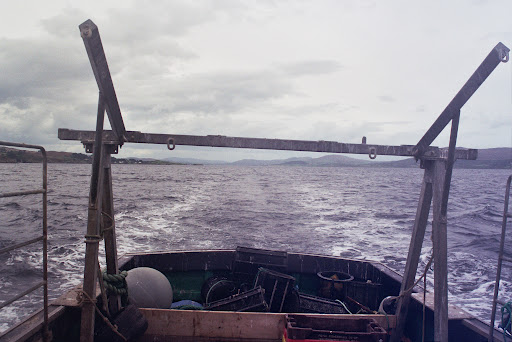
As we headed up the bay we left behind a churn of white water and we were followed by two great black backed gulls who hung in the wind some twenty yards or so back from the stern. Porpoises had been following them the previous week. In Kitchen Cove the boat felt outsized within the circle of water we normally pottered around in a dingy or a canoe. But once out in the bay she was dwarfed by the enormity of the water and the scenery that rose up on either side. I could still feel her power – we were running alongside Kilcrohane after a five minutes, a trip that would normally take us half an hour in our boat Montbretia. Joe, Tommy’s mate fell asleep in the corner of the cabin. Tommy laid out the pliers for nicking the tails of the female lobsters before they are put back and another small sheet of cut metal to measure the length to make sure they were not too small.
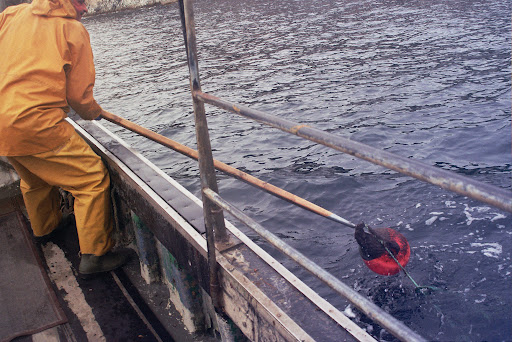
Eventually the boat slows down, Joe wakes up and he and Tommy put on their thick yellow waterproofs. Joe takes up a boat hook as Tommy manoeuvres the boat alongside a buoy just off the the cliffs. Joe heaves the buoy into the boat with the boat hook and the thick wet line is then run through the wheel of a winch that sits behind the cabin. The line is looped around the metal drum, and with a twist of the black lever it starts to haul in the blue line out of the water and it falls in a untidy pile on the deck. It was not so long ago that they did this by hand. The pots are heavy and cumbersome even to carry on the Pier and it must have been hard and difficult work pulling at the cold wet line and the dead weight of the pots in the water.
The first few pots are nothing but by catch, sea urchins, which are thrown back into the sea and star fish which are dumped in a bucket, they are dirty orange and brown, crawling and suckering at whatever they touch. These are the great enemy of the lobster men – they have rasping teeth which chew at the pots and eventually break them. Crabs can be kept if of sufficient size and are heavy enough but spider crabs are put back as at the moment there is no market for them.
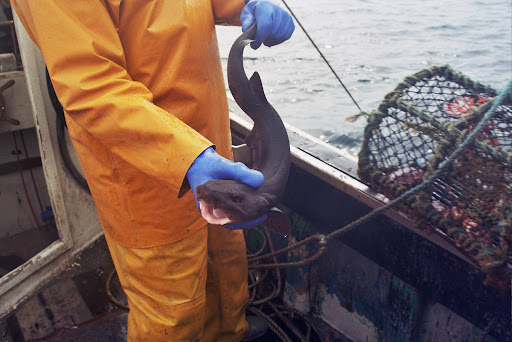
Some of the pots are filled with three or four black dog fish, wrapped around themselves their sandpaper skin would tear at the flesh if they caught you. The big ones are almost 4 feet long with great angry mouths and tiny rows of teeth, there is something dark and malevolent about them. Ireland may not have snakes but these grey creatures writhing and turning over the hand as Tommy pulls them out of the pots make a good substitute.

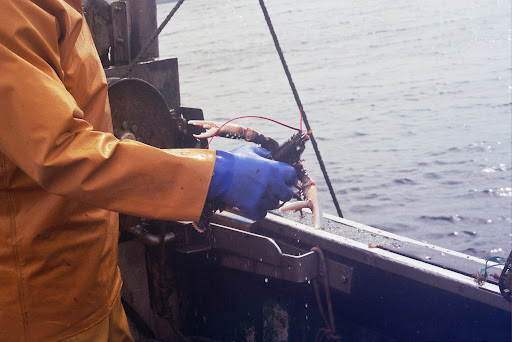
When they arrive the lobsters are surprisingly bright and active as they come out of the sea. In the water they “swim” by clapping their bodies together. Out of the water in the strange air they try to escape with great arches of their back and their claws splayed out snapping at the wind. Tommy and Joe wear thick blue rubber gloves but these would not offer much protection if claw was to clamp its way round one of their fingers. Tommy puts a crab’s claw between a lobsters pincers and they crush it in two. There is a real indignation that they should have been removed so harshly from the safe confines of the sea and rocks where they have no enemy to the boat, all their power gone and useless in Tommy’s fist.
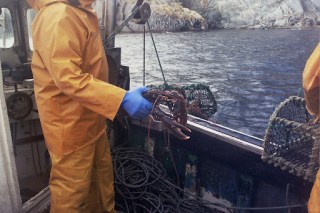
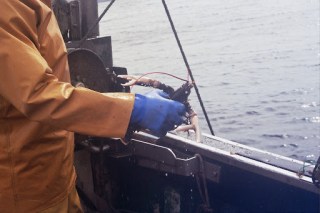
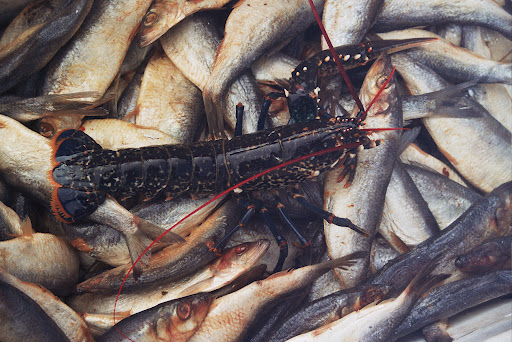
Their colours are particularly vivid, on top not so much blue but a strange off black, mottled and alive in the sudden light and underneath they are pale with a look of burnt skin. They are such primitive creatures and it is hard to shake away the image of them as some kind of giant insect with their rows of small legs scurry against the unyielding surface of the air and the bottom of the boat. To calm them down and stop them from fighting they each have to be covered with a damp cloth. Most of these appear to be old pieces of Tommy’s clothing – torn jeans and jumpers.

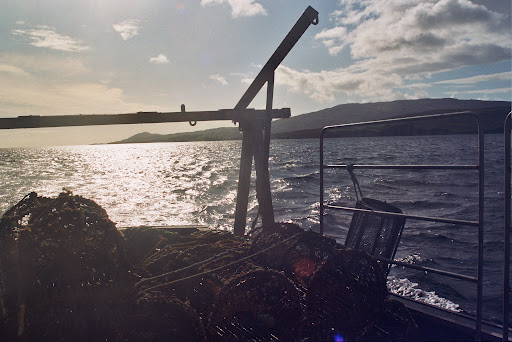
There are about 25 pots on each run. As Tommy empties the pot he passes it to Joe who tips out the last the small crabs which are still hanging on. He then stuffs a couple a ripe herring into the netted pocket in the top. Tommy has to stop the winch every so often to mend one of the pots which the crabs have torn trying to get out. He quickly knits them back together with green twine. The pots are then stacked neatly to the rear of the boat. Once they are all in and the last marker buoy with its tangle of rope has been hauled from the surface Tommy turns the boat round and tells Joe where to lay them again dropping them back into the sea as the blue rope that holds them together unfurls. Gobs of seaweed and great fronds of kelp adhere to the pots – they are encrusted and bent out of shape held together with chicken wire and twine from where they have been torn by the sea urchins and star fish.
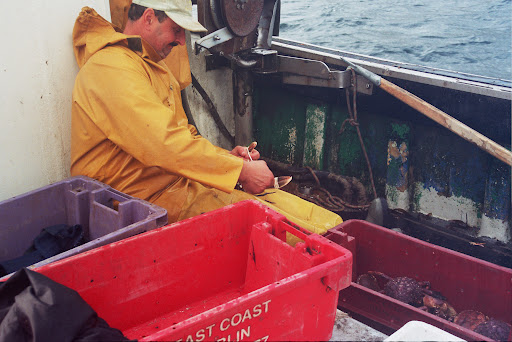
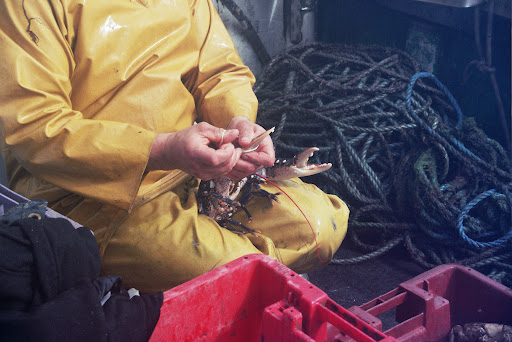
Once a line of pots is out again Joe takes the wheel to motor to where the next line is waiting to be hauled in.Tommy sits against the cabin of the boat next to the boxes of lobster. He takes them out in turn from under the damp cloth, gently cradling the lobsters between his thighs in their yellow sea trousers a plastic bag of elastic bands at his side. The blue rubber gloves are off and Tommy does this barehanded. One band goes on clamping the first claw shut as the other claw arches back and rubs against his hand but cannot quite turn round to get a purchase. He never takes his eyes off them and tells me that part of the learning of this as a boy was getting distracted and having lobster grab hold of a finger.
Once the lobsters claws have been banded they calm down and don’t try to fight so hard and they can be laid together at the bottom of one of the fisherman’s tray at the bottom of the boat under another damp cloth.
The crabs seethe in their black tray. As they are thrown in they aggressively bite out at the nearest crab and they then scuttle and kick to get out of the tray. The odd lucky one is able to get out but is normally caught by its back legs and thrown back in. The luckier ones are able to make it to one of the sluice holes and are able to fall back into the sea.
Over the course of almost two hours a total of five lines of pots are pulled out of the sea. Not all of them are relaid and the last couple are stacked in a neat pile at the back of the boat. They have caught about 35 lobster. Some will be going to local restaurants and other will be going on to Spain and France. We had four of them for supper that evening. Not all of the lobsters that come out of the pots are destined for the table. If they are too small or egg bearing females they go back into the sea. Their tails are nicked with a pair of pliers and it is clear that some of them have been caught a few times before.
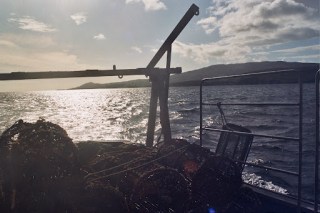
Throughout the year Tommy is out in Dunmannus Bay six days a week. Over the summer the boat leaves the pier at 7.00 in the morning. He is back for an hour or two over lunch and then out again. During the winter they drag for scallops until March, then it is lobster through the summer and from the last few weeks in August it is prawns from pots that are laid across Kitchen Cove. On the day I went out with him the sea and the weather was fairly benign and dry. We were close to the cliffs and so avoided the full heave of the swell that comes in off the Atlantic in the middle of the bay. We watch him as he goes out when the wind is blowing down off the hills and the rain is thick and heavy filling the air with moisture.
We normally have lobsters from him 2 or 3 times each summer. If we are not in the Cottage to collect them when arrives back at the Pier he will leave them in a bag in front of the kitchen door. He never forgets.
THE ONLY WAY TO COOK LOBSTER
Lobster pots
Lobster pots were made locally, possibly for centuries. The sally rods were drawn home from the marshy districts in which they grew freely. A timber frame with holes was placed on the kitchen floor and, while the twigs were still wet and pliable, they were weaved in a pattern until the “trough-shaped” mould for the lobster pots was completed.
The Story of Kilcrohane
Noel Streatfield describes how to her “unending satisfaction she and Rachel [Leigh-White] together hauled in the biggest lobster ever caught in the local bay”. That local bay must be Kitchen Cove. Few lobsters are caught there now. The episode is described in some detail in The Growing Summer when the lobster is caught at night. Boys fall into the water and spend the night on what I suspect is Owen Island.
Should you come across a lobster and it is alive and kicking and fresh from the sea when you come to cook then do not be misled by the many recipes there are for the cooking of it. There are numerous suggestions for sauces and the like but my belief is that you should keep it simple. So prepare to get your hands dirty.
First of all you will need to get over the fact that you will have to kill the thing. Don’t worry too much about this, as it will die happy knowing the pleasure it will bring to you. To prepare it I would put it at the bottom of the fridge with some seaweed on top of it. This will feel like home and lull it into a false sense of security if not send it to sleep.
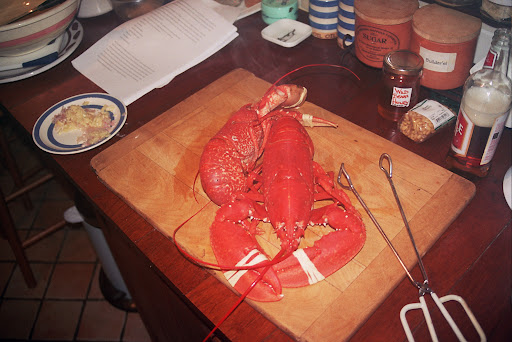
Take a large vat of seawater and bring it to the boil. When it is at a rolling boil carefully remove the lobster from the fridge (you don’t want to wake it) and place it gently as possible into the boiling water. It will die straight away and almost immediately will turn the traditional shade of red. Cook it for about 20 minutes; it will need roughly 20 minutes a pound.
Towards the end of cooking time take half a pat of butter and warm it gently in a saucepan together with 3 well crushed cloves of garlic, a good handful of chopped parsley and salt & pepper.
When the lobster is cooked remove it from the water. Place on a large board and find your biggest and sharpest knife. You will need to split the lobster. This means placing the tip of the knife at the back of its head where there is a cross and plunging in. The head should cut in half fairly easily but you may need a sharp pair of scissors for the back part.
Place the split lobster (or lobsters if hopefully you have more than one) on a large plate and pour over the melted butter.
Eat with lashings of the most expensive white wine you have drunk out of tumblers.


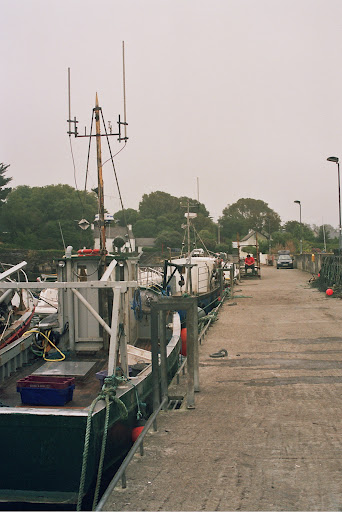









 Sheep's Head Food Company