Chicken and noodles

If your youngest daughter tells you that you have just made the best tea ever it is worthwhile making a note of what was cooked in case of being asked to do it again.

Cora has always loved noodles. Some of the most memorable that we have had were at Hong Kong Airport on the way to Australia. We were stopped there for a couple of hours and arrived in the very early morning. We were bewildered with the lack of sleep. Galen had a milk shake and Cora and I settled down to two big bowls of chicken noodle soup. It was very sustaining and the best meal we had in the 28 hours from when we left home until we got to Melbourne.

This was a vague approximation of that soup from Hong Kong Airport.


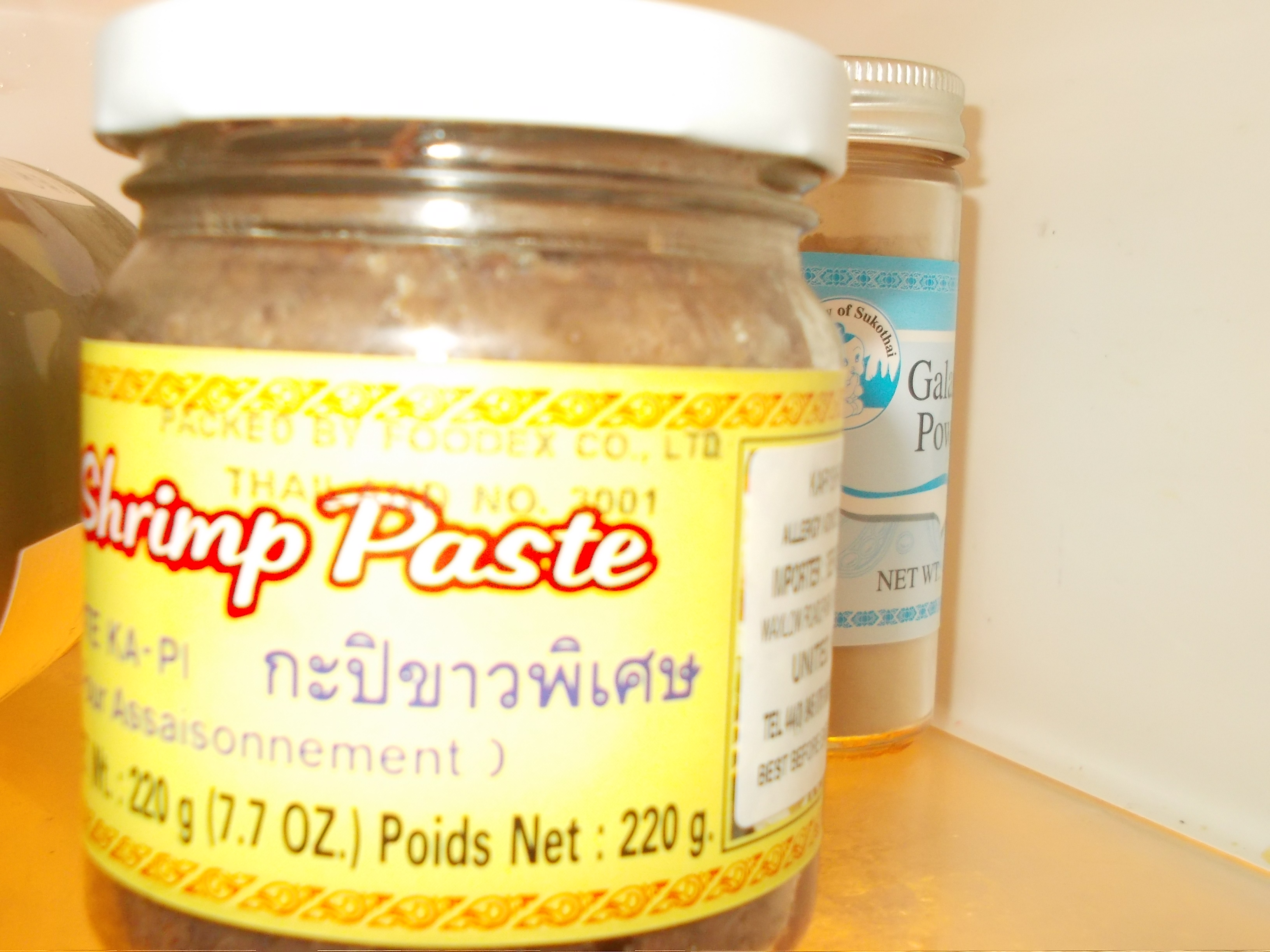
I heated some groundnut oil in a large pan and threw in a chopped knob of ginger, a couple of sqashed cloves of garlic and the green leaves from a bunch of spring onions. I then dropped a small whole chicken into the pan a let it brown for a few minutes in the hot oil. As I was doing this I added some pungent fermented prawn paste and tamarind water.I had already boiled a kettle full of water and I poured it over the chicken until it was just covered. I brought it all back to the boil, put a lid on and let it simmer until the chicken was cooked through.


Whilst that was cooking I finely sliced the rest of the spring onions and roughly chopped up some baby sweet corn, mange tout and a small red chilli.

After the hour was up I checked that the chicken was done. It was then lifted out onto a large plate to cool for a few minutes. I strained off the stock and poured it back in the pan. It still tasted a bit bland so I boosted the flavours with some more shrimp paste, a good dash of fish sauce and a couple of tablespoons of sugar. If there had been one to hand the juice of a lime would have gone well.

Using a sharp knife and a fork I stripped the meat from the chicken cutting away the skin as I went.

To finish off I added the chopped veg to the simmering stock and let them cook through for a few minutes. I then stirred in a few packets of noodles breaking them up with a fork. Finelly I added the chopped chicken and decorated it all with some finely chopped coriander.
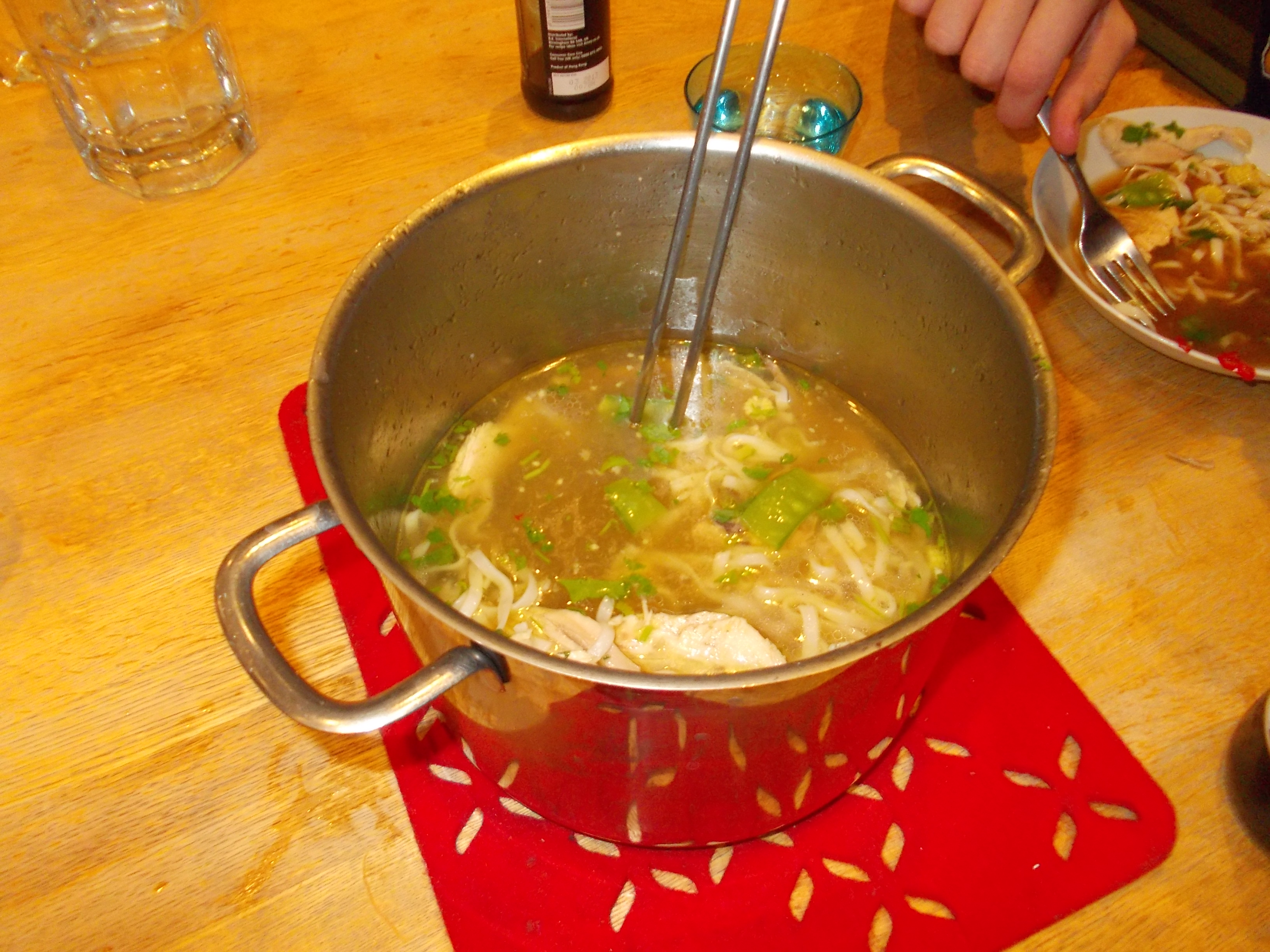


I served it out of the pan at the table and we ate it with spoons and forks making a mess as we went. I told the kids about the scene in Tampopo where a group of Japenese business men are eating in an italian restaurant. they are all nervous as to what to order until their most junior member does it for them in perfect Italian. When the spagetti arrives they try to ear with the a spoon and a fork like you would noodle soup. The same office junior shows them how it is done twirling the spagetti round his fork using the spoon as a base.


Having just had a look at the scene on YouTube I have of course got my memory of the scene mixed up and completely wrong. It is still worth having a look at them eating noodles…

Aubergine with yogurt

One of my favourite dishes. I had it last week in Morito – a small terracotta dish of spiced lamb, aubergine, yogurt & pine nuts. When it came there some pomegranate seeds on top as well. It was delicious the raw taste of garlic mixed with the smoothness of the aubergine and the slight crunch of the fried lamb, the nuts and the seeds.

I first made something like aubergine and yogurt when were living at 72 East Avenue in Oxford. I think it might even have been for the party I had for my 30th birthday. I have been trying to remember from which book I got the recipe. Going through the shelves I think that it must have been from either Claudia Roden’s book of Middle Eastern Food or the BBC book she did on Mediterranean Food.  Properly the dish is called either Baba Ghanoush in Arabic با غنوج or Moutabal   and I am sure that I read somewhere that one the translations has something to do with the harem.

The recipe out of the Mediterranean book is almost exactly the same as that set out below save that Roden adds lemon juice and tahini paste. There is no yogurt in the version out of her Middle Eastern book.

The important things are to have the smoky flavour of the the creamed aubergine and the raw brute taste of garlic to offset the smooth texture on the tongue.

Take two good aubergines, pierce the skin with a sharp knife, and place them under a hot grill. If it is summer and the barbecue is going put them on the rack. It doesn’t matter if the skin gets burnt and charred as you will not be eating that. Depending on the size of the aubergine they will take 45 minutes to an hour. Turn them over every so often until they are cooked through and the flesh gives when poked with a finger.

Take away from the heat and allow to cool so that they can be handled.

Whilst they are cooling crush a couple of cloves of garlic in salt. I use a large heavy bowl and a wooden pestle to do this.

Take up the sharp knife again and split the aubergines lengthwise. The pale cream coloured flesh should be soft and forgiving. Scrap it out with a spoon and add to the bowl with the garlic. Then using the same pestle break up the flesh until it takes on the consistency and smoothness of a thick double cream. Stir in a few good teaspoon of yogurt to temper some of fire of the garlic. You could also add some olive oil if you wanted. Check the seasoning and add some salt and pepper if you think it needs it.

Put into a serving dish and eat with flat bread warmed in a large frying pan.

You could decorate the dish with pomegranate seeds or pine kernels and perhaps some finely chopped parsley.

This evening we have been listening to a new compilation from Jonny  Trunk called Lard. 70 minutes of weird strange folk, jazz and nursery rhymes all wrapped in some Seventies Sainsbury packaging for Lard!

Field mushrooms

We had friends to stay last night so there was food to cooked. Saturday morning was the usual cavalcade from the greengrocers on Oxton Road onto The International Store and then down to Wards. Wards had run out of red mullet so I settled for Grey Gunnard knowing that they were far better value. But I do want red mullet next weekend so I will have to get out of bed earlier.

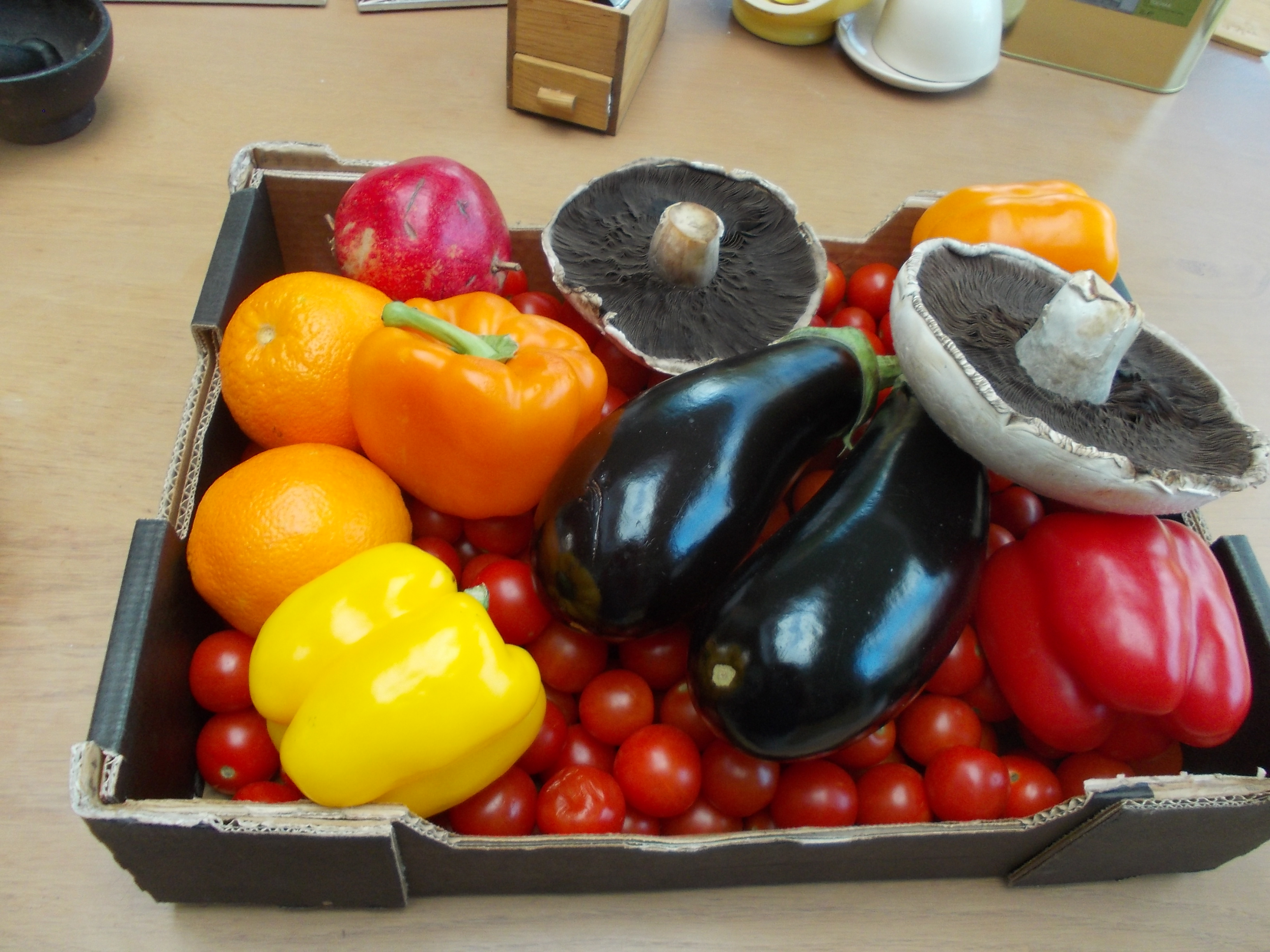
In the greengrocers they had a box of giant field mushrooms some of them at least six inches across. I had not been planning on cooking mushrooms but they looked so good I got a couple, together with a box of cherry tomatoes for soup, another half dozen quince because they were there, aubergines, peppers and beetroot.

Back at home the tomotaoes were cut in half and poured into a pot in which I had been cooking a couple of chopped onions, garlic and red pepper. For flavouring I stirred in a good few pinches of cumin seeds and a knifefull of ras el hanout. After 45 minutes the tomatoes had collapsed and I put it all through a fine sieve.

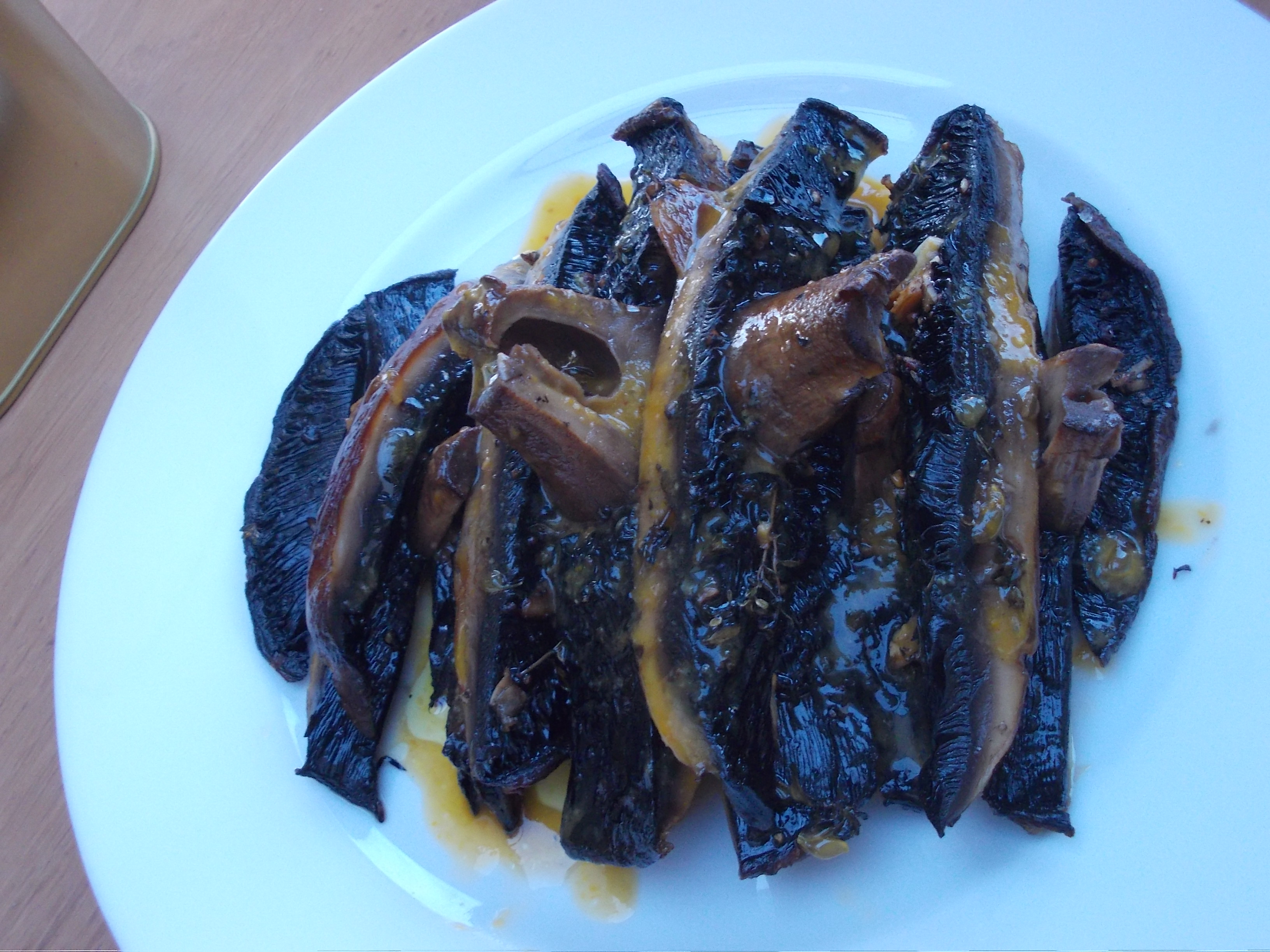
I cooked the mushrooms at the same time. I placed them in small roasting dish and they were doused well in olive oil. They were a couple of satsumas in the fruit bowl, so I peeled one of those and tucked the pieces under the flap of the mushrooms together with a chopped clove of garlic and some sprigs of thyme.

I covered it all in foil and put them into a warm oven for an hour. By then the mushrooms had started to collapse into themselves. I cut them into slices quarter of an inch thick and arranged them neatly on a white plate. There was some juice still left in the pieces of satsuma and I squeezed this out with the back of a spoon through another fine sieve.

We had the mushrooms as part of the starter. There was also a plate of peppers cooked down in olive oil and garlic for an hour, roasted aubergine with yogurt and the beetroot, boiled until soft then blitzed in the Magimix together with horseradish root and some walnut oil.

The Gunnard were baked in the oven and served on linguine.

The quince went into the oven as well, whole with water and sugar and then served in a bed of whipped cream.


A very tough old fowl exploded and a walk through Flaybrick Cemetary

Of course when it came to the boiling fowl I should have turned to Dorothy Hartley. She has this to say on how to make a really tough on fowl tender.

“….get the largest bird you can find. It does not matter how tough it is. Draw it and truss it. Put a couple of onions inside and set it to simmer very slowly overnight, letting it go cold in the water as the fire dies down towards morning. There should be a skin of fat on the broth. Take this up and set it aside, but leave the fowl to soak in the broth.

Two or three hours before dinner next day, bring the pot again slowly up to boiling point. Meanwhile, have your oven ready as hot as possible, fiery hot-and a baking pan well greased with the fat from the fowl. The minute the water begins to boil, lift out the fowl, dredge it thickly with pepper and flour, and instantly shove it into the hot oven. Close tightly and leave for 10-20 minutes, according to size.

When taken out, the breast and skin should be brown, and crisp as if roasted, but the fowl still damp and juicy inside. Scientifically done, it will almost fall to pieces when carved, as the steam from the boiling broth, superheated in the hotter oven, explodes, and, quite literally, blows the whole contraption to pieces.”

I have not been as ambition as that and have settled for chopping up the bird, dousing it in half a bottle of red wine and a tin of tomatoes and leaving it to stew for a few hours while we went for a walk.

The walk was to clear out some of the lines of sleep from the late night and wine we had last night. Flaybrick Cemetary is a 10 minute walk up the road. You need company when walking round as the dead lurk near the surface. It was built in the 1860’s to accommodate  the passing on of the growing population of Birkenhead. It now covers around 26 acres sloping down from Bidston Hill.

It is a broken, tumbled down place. Many of the gravestones have either been pushed or have fallen over, the Victorian grandees now grassed over, the names finely engraved now lost under the leaves.

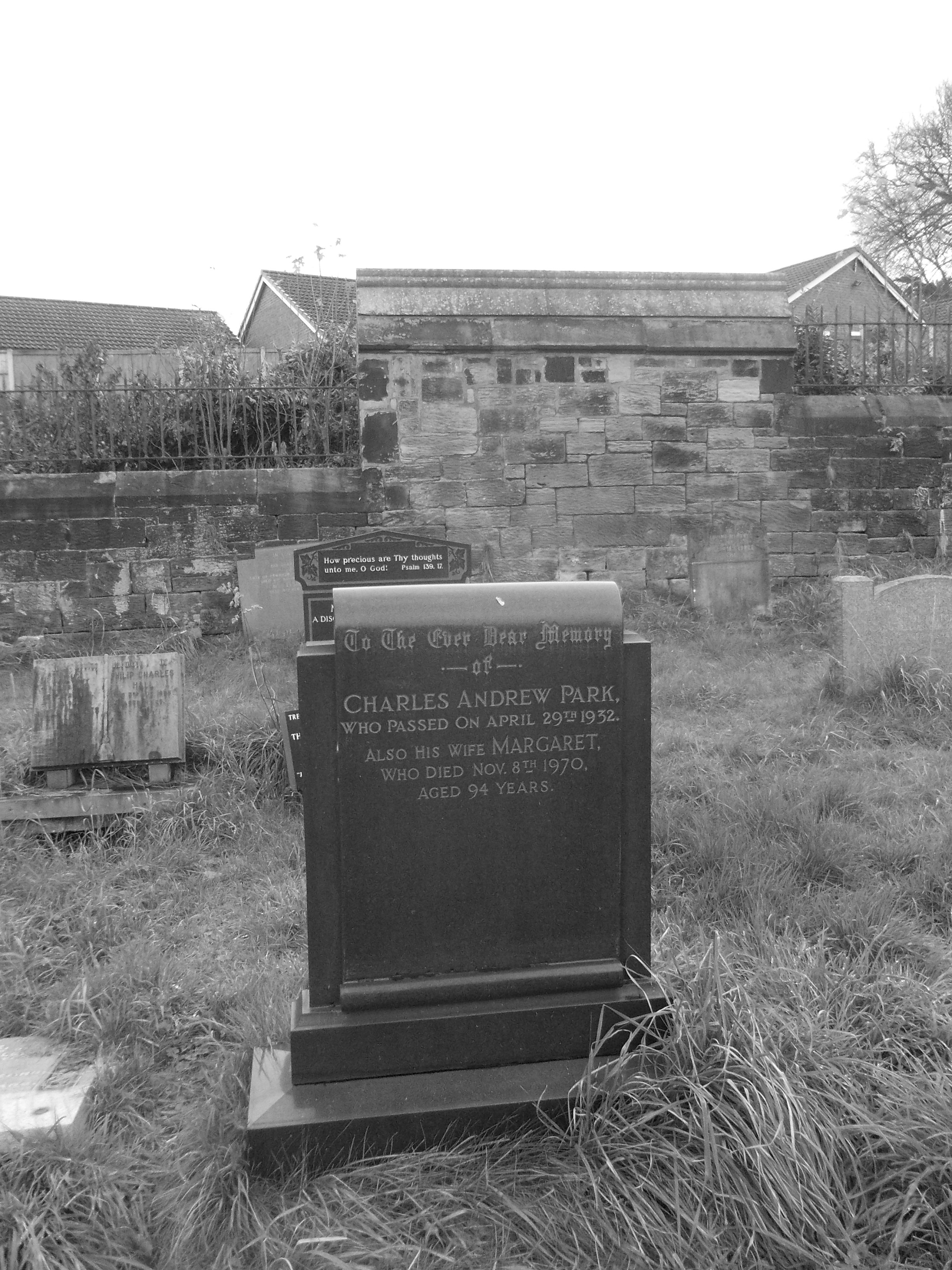
I was struck by the story behind one gravestone, Charles Andrew Park who died in 1932 and his wife Margaret who died  38 years later in 1970 aged 94. Was the space left on the gravestone for the children they did not have and how did her memory of him turn  over the years.