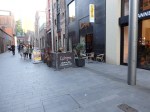
Walking down Church Street yesterday morning I was grumpy. Part of the grump was brought on by knowing that I did not have enough time and money to allow myself to be diverted into a bar and record shop and would have to concentrate on the matter at hand, which was the buying of a suit. The rest of the grump came from the sheer noise and cacophony that came from the street performers who were situated every hundred yards along the street.
Each of them had their own mini-generator that made a racket on its own and then interwoven through that noise was whatever music the performer or performers were playing be it an electric guitar or a full blown band or a drummer who seemed to be playing just one elongated drum solo which was then meshed in with the noise coming from the performer a hundred yards either side of the one you were stood closest to. Even the man performing tricks with a football seemed to be making too much noise.
All this noise was thrown into to sharp relief later that evening as I walked up Jamaica Street towards The Liverpool Festival of Psychedelia 2014 that was taking place in Camp & Furnace. A quarter of a mile away I could hear the rumble of bass loud enough to rattle windows and a guitar solo that started as it meant to go on – forever.
I stop off in The Mad Hatter’s Brewery for a fortifying pint and resolved, one day, to make a proper evening of it in there. Having finished that pint I ventured the final few hundred yards to the festival and into Greenland Street.
Walking into the venue I could feel the floor shudder under my feet with the noise. I bought myself a drink and the whole transaction was conducted in sign language. There was no point trying to say anything. Anything that could be said was swallowed up in the maelstrom of pure noise that was coning from the stage. I moved closer to see what was going on.
In Spinal Tap they doctor the lettering on the amplifiers so the volume knob goes up to 11. Saturday night in Camp & Furnace and they had been a bit more methodical about it. Someone had obviously taken the amplifiers apart and had a go with their insides with a spanner and screwdriver and rewired them so the volume had nowhere else to go but be a little a bit louder and then loud some more when a guitar was hit with sufficient force. So far as I could tell the floor was solid concrete but every so often it would shake as another wall of noise crashed through the room and I could feel the crease in my trousers vibrate.
There were three bands I wanted to see and leading up to them and in-between times I watch a half dozen or so other bands who all seemed intent on seeing how far they could push the “How loud can I go” experiment.
Five years ago I was taken to see a band called God is an Astronaut. There were three of them on stage with a video behind. Each song started quiet for a minute or two before getting louder and louder and then louder some more. All the while the video behind the band showed pictures of bigger and bigger bombs going off. There were parts of Saturday night that took me back to that gig.
Fortunately there was a bar selling real ale so as I moved from stage to stage watching different bands see how loud they could go I was able to keep myself fuelled with pints of Liverpool Summer Ale until the first of the three bands I wanted to see came on.
Any band that calls itself September Girls is selling itself to me even if they can’t spell Gurls right. When they are five women from Dublin playing spiky guitars and songs that seem to crash into each other then all is alright. Mix into that the added bonus of songs that last for three minutes or less then we almost have the highlight of the evening. John Peel would have liked them.
After that it was Woods. I have managed to pick up three of their albums over the last couple of years. They are difficult to put into a pigeonhole but they could be heading towards being one of the best American bands. They shook things up on Saturday night by turning the volume down and taking out an acoustic guitar for a while. They were the best band of the night for me.

After Woods the volume went up again and there were a couple more bands to be got through before we got to Goat who came on stage about 1.30am. They played a shamanistic blend of funk, hi-life, Jimi Hendrix guitar which every so often had the potential to shift into some sort Grateful Dead like gear into the cosmos and all the time wearing masks. The volume went up and at times it felt as if my ears had shredded but then they went a little bit louder and I could still hear so all was okay. It all got very hot and sweaty and I found myself wondering how many other lawyers there were down the front jerking around to to the music. I should really be doing something else with my life.
After that there was a happy 45 minutes spent trying to find a taxi home and all the time marvelling over the people in Liverpool at 3.00 in the morning.
Tea before I went out was fish’n’chips. They were very good.