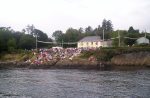
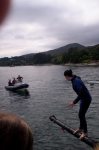
It was Saturday during the Ahakista festival in the first weekend in August. The sun and the crowds had come out. The morning and early afternoon had been taken up with the rowing. The boats had gone and it was now time for the regatta. It was the greasy pole, lashed down and stuck out at the end of the pier with a red rag tied at the end. Children and teenagers gathered round, shouting each other on and each in turn fell off ten feet into the cold water below. There were a variety of methods, from those who thought if they ran it quickly they could get to the end before falling off and those, mostly the girls, who tried to do it slowly and carefully, arms outstetched for balance. The all fell in. The only one to do it was lad who shimmied along on his hands and knees and they all shouted at him for cheating.
I was sat on one of the wooden tables in Arundel’s beer garden, the scrub of grass that led to a slope down to the water. There was a bewildering amount of activity. Cars were being diverted around the back road and crowds of people walked up and down the road from the pier to the pub. The Cottage seemed lost with the people.
A ship from the navy had come into the bay and was parked just behind Owen Island. If the weather stayed right we were promised a helicopter display and rescue. The ship looked out of proportion, too big for the bay, it loomed up and over Owen Island, it seemed to diminish the water.
I was sat with the the man with a black beard. We were drinking our pints slowly. There was a scrum in the pub. Despite the extra people working behind the bar they could not keep up with the crowds and so we were making the most of what we had before going back to fight for our next pint.
The man looked out at the boat. ‘There was a time,’ he said,’A boat that size could come into the bay and there were so few people here it could hide here for day or two without being found.’
He drank at his pint.
‘My father, he had a story about the Emergency.’
When I looked puzzled he explained. ‘The Emergency that was your war with Germany. Ireland stayed out of it and took no sides but it was still a hard time. Our ships were still sunk and then men still died in them. There was no food that came in from out of the country and we had to rely on ourselves. But it was a quiet time here. The people they got on with their lives and we didn’t go hungry.
‘Mrs Black-Fore she was stuck in her Cottage for four years and made no trips back to London and she let the place get tired for a while.’
‘My Dad he said he was the one who saw it first. It was early summer May or thereabouts and he and the family lived in a cottage on the old road to Kilcrohane on the way to Rossekerrig. It is high there and there is a good view across the bay. My father, he must have been about ten at the time, was up early on some job with the hens and he looked out over the bay and there was a feckin’ great grey boat there low in the water parked about where that boat is out there now. There were pictures in the papers and he recognised it as a submarine and there was a rubber boat that had been let down from the side and there was a group of men rowing towards the pier.’
‘My dad he forgot about the hens and he shouted back in the house for his brothers and the his father and then he ran down to the pier. The pier was small then, about half the length it is now and there was no slipway to pull the boats up. But there were still two fishing boats that worked from it and there were a few other small boats tied up along its length.’
‘My Dad then he ran down to the pier and by the time he got there there was a group of men stood at the head, Tom Arundel was there and Dennis O’Mahony and few others. Two of them had their shotguns with them although they kept them low down. Together they walked to the end of the pier and they watched as the rubber boat rowed up to the end.’
‘There were five men in the boat and there was no telling if they were English or German. They wore dark jackets and each of them had a thick beard. Even as they were pulling in my Dad said you could see they were tired and anxious to get their feet on the ground. They tied the boat at the end of the pier and the five men climbed the metal steps to the top of the pier and then men from the village and the men from the boat faced each other.’
‘My Dad said it was Dennis O’Mahony who spoke first and he asked them if they had been out on the water for long.’
‘The men from the boat looked older than their years. They wore heavy wool trousers and jumpers under their black jackets. Before they started to speak they put their black hats on and then men from the village saw the German marks on them. There was a leader and he spoke in German at first and then when saw they didn’t understand he said in broken English, “It is okay. We stay here a day to rest.” Dennis O’Mahony waved a hand back over the bay, “There’s no permission needed here. You to stay to rest if you want to.” ‘
‘The men from the village walked back down the pier but they didn’t go home. They hung back to see what the men from the boat would do and my Dad sat down at the side of the pier and put he legs down over the side his feet above the water.’
‘The men from the boat talked for a while and two of them got back in their dingy and took it back to the boat. Their leader, he must have been the Captain, and other two walked back down the pier and up again and my Dad said he could see their steps grow lighter as they went as if the weight of the boat was being lifted from them. As my Dad was sitting there they said something to him in German and they laughed at him and my Dad looked back at their dark beards and their lined faces and their clear blue eyes.’
‘Dennis O’Mahony went to knock on the door of the Cottage and he spoke to Miriam Black-Fore to tell her what had gone on. She came out on the pier and the men from the boat looked surprised to to see this tall woman. She walked up to them and there was more surprised when she started to speak to them in their language. She asked them some questions and the Captain answered her and he seemed pleased to be able to explain where they had come from. Miriam Black-Fore then spoke to Dennis O’Mahony and told him they had been away at sea for three weeks and they were on there way back home. One of the men from the boat had stopped off around here before the war and they had talked about and decided to stop for a day in the quiet before they went back to their fighting. There was no bother about them.’
‘Two more rubber dinghies came out from the boat and soon there was another twelve men on the pier. They left some back on the boat and they waved at each other. It was a still hot day and and they were hot in their woollen trousers and jumpers. One of the men pulled off his heavy clothes and dived into the sea from the end of the pier. He swam out into the water gasping at how cold it was and shaking his head shouting at others to join him. Some of them did and soon most of them were in the water. They were enjoying the freedom of it all.’
‘The Captain kept away from his men. Watching them and watching the men from the village. It must have been another world for them. Locked up in their tin can for weeks at a time sinking ships and being hunted down and then to be out in the sun light and splashing and playing games in the water. During the day some of then went back to the boat and others came back so they took it in turns. The Captain stayed by the pier. The men from the village went on their way but my father stayed to watch.’
‘At some point the Captain went to knock on the door of the Cottage and he spoke again to Mrs Black-Fore and after a while they sat down on the metal chairs in her garden and they carried on talking. Mrs Black-Fore had been to University in England and had travelled and my Dad he heard later that they found there were people they had in common.’
‘The two of them walked up to the pub and Mrs Black-Fore spoke to Tom Arundel and he then came down to the pier with a tray of pints. There was no talk of how they were paid for. Those first pints were drunk quickly and the Captain then spoke to his men. There were more trays that came down that afternoon but the drinking of them slowed.’
‘It was hot through the day and as the afternoon moved along some of the men from the boat slept out in the sun and their pale bodies coloured and went red. My Dad said that as the day went on some of the tiredness lifted from them and the water washed away the lines in their faces.’
‘One of the dinghies was taken out for fishing and they came back with two buckets of mackerel. They built a fire on the patch of ground there by the pier and round the back of your Cottage. One of the men spoke to Mrs Black-Fore and she spoke to my Dad and asked him to fetch a pot of cream. My Dad did that and handed the pot to the German. He was holding a thick grey root. He cut off a small nick and gave it to my Dad to taste. He bit down on it and then spat it out as the heat from the horseradish caught at his nose and made his eyes water. The German laughed and then took a sharp knife and cut at the root on a stone. Peeling it and chopping it down to a mash his eyes watering as he went. He mixed all that with the cream.’
‘They cooked the mackerel on the open fire in the early evening and ate them with their fingers dipping the fillets that they pulled away with their fingers in the creamy hot sauce.’
‘They kept the fire going all night and for a while most of the men were here on the shore. Some of them slept outside that night on the beach. The Captain and Mrs Black-Fore sat on their chairs in the garden and they talked until late that night. There was some whiskey he had from the pub before he took himself back to the boat.’
‘He was back early next morning waking the men on the beach. They were covered in dew. The men from the village gathered again to watch them go and there was some shaking of hands. Mrs Black-Fore spoke in a low voice to the Captain and then they all rowed themselves back to the boat.’
‘My father watched as the men like small insects out there pulled at the ropes and he said you could hear the thump of its engine as it started and the boat moved out of the bay.’
We had finished our pints. On the pier they were getting ready to chase the duck. A group of shivering boys was crowded onto the slip way and Thomas Cutter was out in a boat with a box with the duck in.
The man with the black beard called out to a small boy who was walking past.’Here Patrick take this note here and go to the bar and buy us both another pint.’ He handed over a ten euro note to the boy.
‘My Dad said that when the Emergency finished Mrs Black-Fore asked some questions about the boat and it seemed it never got home. Well they had their light for the day.’