

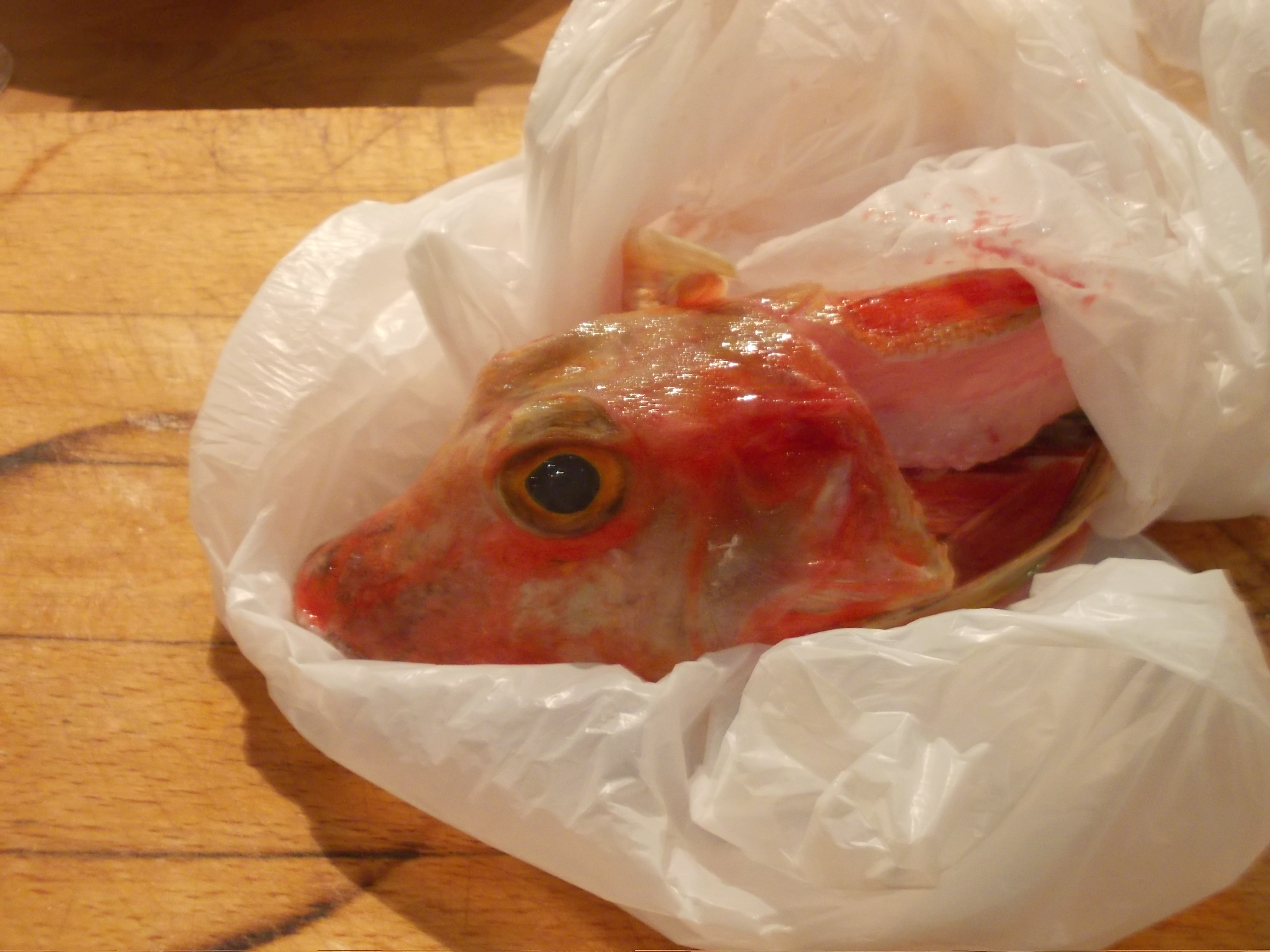
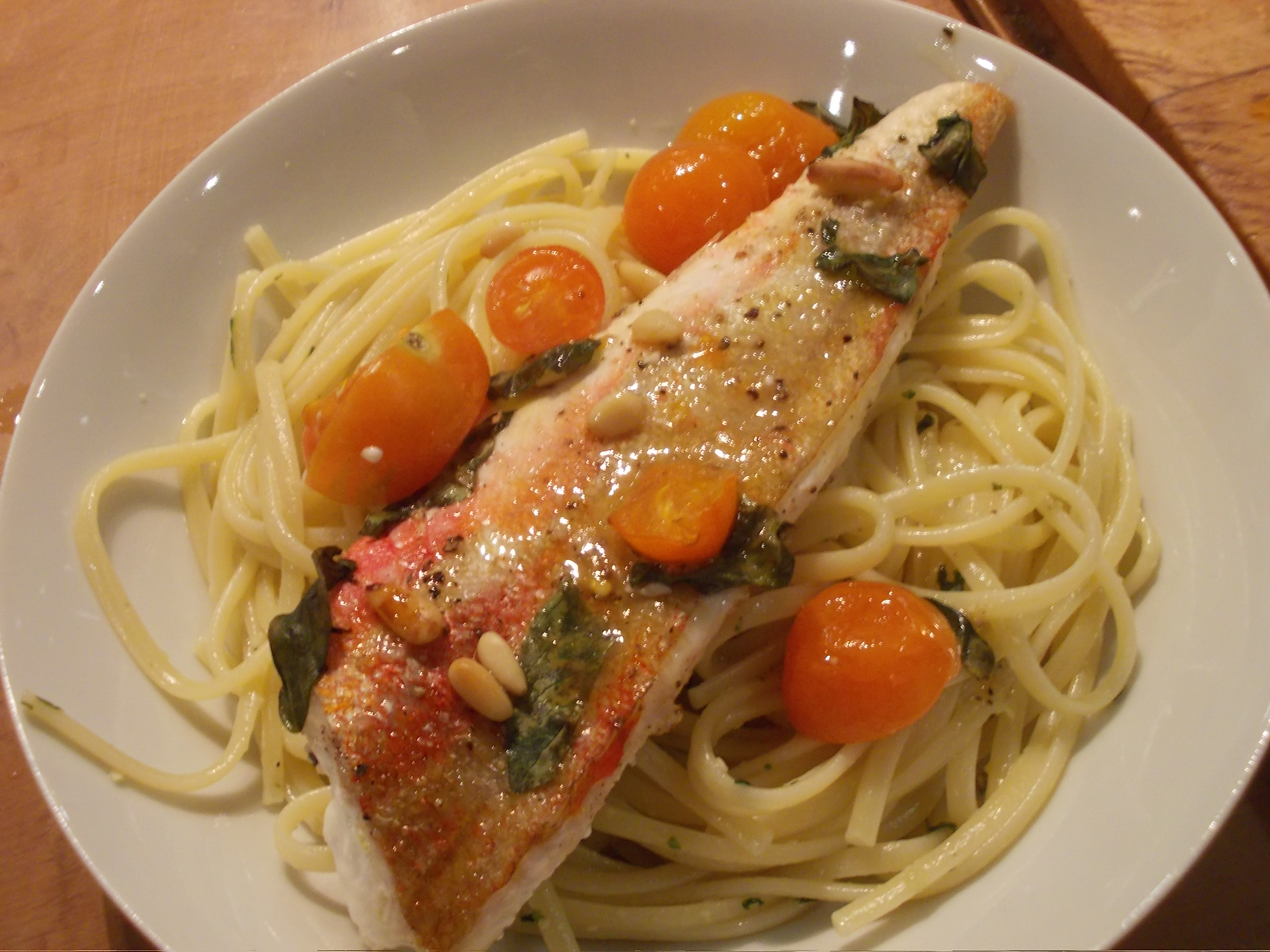
The raw red colour of the Gurnard’s head on Saturday evening reminded me of a picture I took perhaps five year ago in the open market in Oporto of a skinned sheep’s head. I was in Oporto with Richard and Pete. The market was one of those places which made you wish there was a small kitchen back at the hotel so we could buy up some of the fish and cook them. I consoled myself by buying a 5 metre length of dried intestine to used for making sausages.
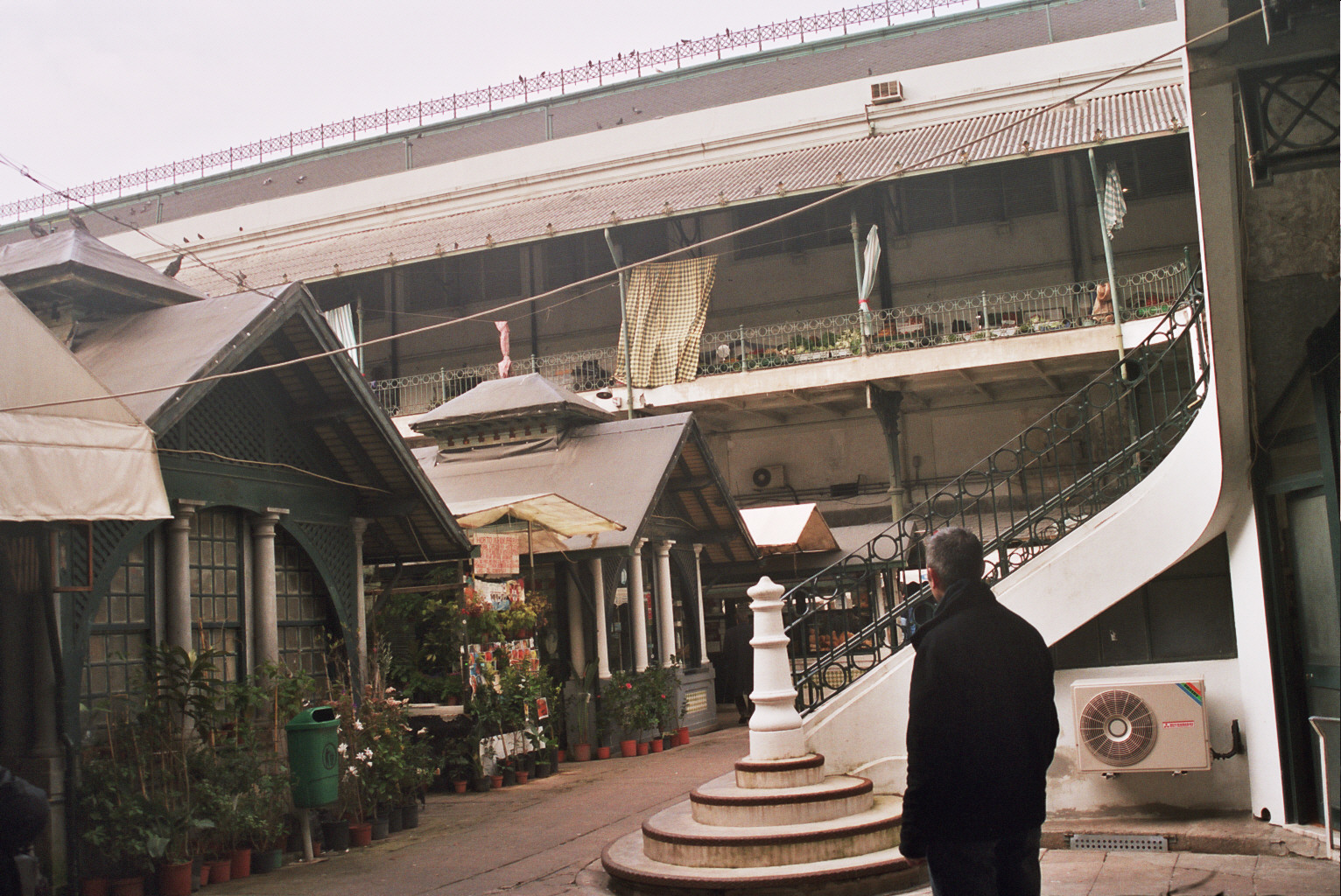
Of course with this blog being called after The Sheep’s Head time has been spent giving thought as to how one go about cooking a sheep’s head.
Buy the head already split lengthways and remove the brains carefully. Place them in cold water to which vinegar may be added. Chop off the nose, and soak the head in tepid water for half an hour. Cleanse the head thoroughly, and blanch as follows; place in a saucepan, and cover with cold water, bring the water to boiling point, pour off the water and rinse the head. Remove the tongue. Tie the two halves of head together. Boil gently for two hours with the vegetables and tongue. Either serve the head whole, coated with brain sauce, or serve the meat and tongue cut in slices. Sheep’s trotters can be added to the above recipe if required. Wash, blanch, cook and serve with the head.
This was found by putting the words ‘sheep’s head’ into Google. The site it was from talked of it coming from ‘my grandmother’s old cookery book, written in the 1920’s and full of stomach churning recipes like eel pie, and sheep’s head.’
The recipe is a combination (and confusion) of two taken from The Radiation Cookery Book, compiled for the special benefit of the many thousand users of Regulo New World Cookers, published, in eighteen editions every year from 1927.
Millions of copies were distributed as they came free with the new style gas cookers. By 1939 there were eight to nine million new gas cookers in households across Great Britain making The Radiation Cookery Book one of the most available and perhaps influential cook books ever. The books carry a sense of the new world and optimism. The gas cookers they came with offered convenience and technology and escape from the drudge and hard work of solid black iron stoves forever in need of stoking and cleaning.
There was a copy of the Radiation Cookery Book in the Cottage when we first went there. I have it now by my side. There are three recipes for mackerel; two for baked and one stuffed.
Mackerel baked (1)
3 or 4 mackerel
half a pint of brown stock
2 tablespoons of vinegar
chopped parsley
Clean the mackerel, cut crosswise a few times down each side, and season with salt and pepper. Place in casserole. Pour stock and vinegar around the fish: cover with greased paper. Bake the fish for 30 minutes with the “Regulo” at mark 5. Place the fish on a hot dish, sprinkle with the chopped parsley and pour the gravy around them.
There are old cuttings from newspapers and the Sunday supplements still with the book. They hardly seem touched. Just carefully folded and left there.
I cannot remember if the oven was a “Regulo” when we first bought the cottage. I know that it was old and it probably did not differ too much, if at all, from the original tool.
The recipe from Google combines the instruction for both Sheep’s Head Broth and Sheep’s Head. The vegetables are carrot, turnip, onion or celery. The Regulo Cookbook goes on to describe the making of a broth using pearl barley and thinking on this led me to the great describer of old English food, Dorothy Hartley.
An excellent dish, but one that takes time. Let the butcher prepare the head, splitting it in two and removing the eyes and offal and brain. Wash in running water till it runs clear, then put into a thick stewpan with 2 whole onions, 2 chopped carrots, the top part of a stick of celery, a couple of cloves, a bay leaf and a faggot of herbs, 3 or 4 peppercorns, salt and about 3 quarts of water (or less-the head must be completely covered). Set over heat, and as soon as it boils , skim carefully (this is important). When it stops “throwing up” scum, draw the pan aside and let it all simmer for about 2 hours, or till the bones are loose and lift out easily. Tilt the whole boiling out into a colander, or sieve, rinse out the pan, and pour back the liquid, adding a handful of whole barley and a fresh supply of nicely cut and prepared root vegetables-carrots, turnips, celery, parsnips, etc.-in great variety but not potatoes, as they cloud the broth). While these boil in the broth, carefully pick over the meaty pieces from the head, pepper them lightly and scatter with some fresh minced parsley (not much of this). Re-warm the pieces of meat with the freshly cooked vegetables and serve the meat and broth in deep bowls, with the vegetables, and bread or potatoes handed separately. Dumplings are added if liked, but they should be small and light.
A properly prepared dish of “sheep’s head meat” is a very delicate and very nutritive dish. Note. The onions are put in “whole”, as the outer skins make the broth a rich, brown colour.
If you are lucky you might be able to pick up a copy of the Radiation Cook Book from a second hand bookshop. If you can’t get a copy then there is a whole world of food available from various Women’s Institute Cookbooks and either the local charity book put together by the local great and the good in aid of a nearby hospital or rather tatty paperback put out 20 or 30 years ago to celebrate local farmhouse cooking. From these sort of books it is possible to distil a proper sense of British cooking, of food done in the kitchen, made to work, tasting best with local ingredients made good.

How the Sheep’s Head Peninsula got its name remains something of a mystery.
There is an explanation of sorts for the name from a confusion for the translation of Rosskerrig, the townland and hill, that sits to the west of Ahakista.
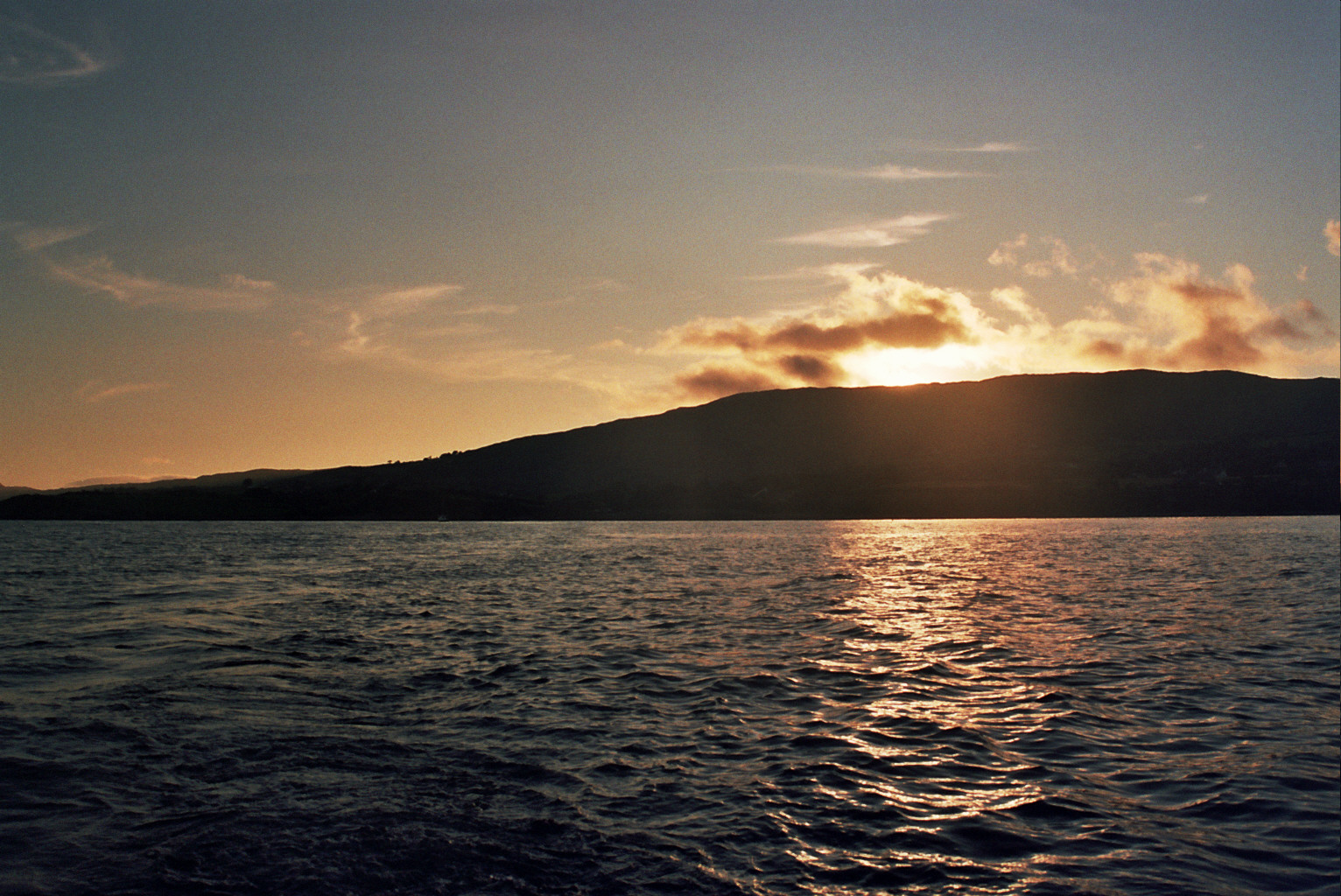
Twenty or so miles inland and east of the peninsula there is a place called Gougane Barra, a lake with a short promontory to what was an island on which there are the remains of a small monastery and the graves of the monks and saints that once lived there. On the first day we went it was a grey and wet place amidst mountains and hills shrouded in mist, sheets of rain coming round, leaving us the only people to walk about the stones.
Amongst the distinguished scholars of Gougane Barra there was a Saint Euhel of Ros Coerach. Ros Coerach was identified with Rosskerrig and Ros Coerach translates from Gaelic as “Sheep’s Head Promontory” or “Head”. The English translation of Ros Caorach is “Sheep’s Head” (“ros”, a promontory, “caora”, a sheep).
There is nothing that I know about Rosskerrig to connect it with a monastic history but a few miles along the coast, just short of Kilcrohane, there are the remains of a Bardic School and a monastery at Dromnea, near the lake at Farranamanagh where legend talks of two Spanish princes who were drowned and buried only to haunt the place still as a pair of white swans that make their home on the brackish, brown waters of the lake.
The Gaelic name for the peninsula is MUINTIR BHAIRE but it is now more usually known as The Sheep’s Head. Muintir Baire translates as “the people of Baire”. Baire was a member of CORCA LUIGHE, or the race of LUGHAIDH. “The Genealogy of Corca Luighe, as found in the Book of Lecan, is a fifteenth-century compilation by MacFirbis. Clearly, the race of Lughaidh was widely dispersed in Ireland but one of the most authentic settlements in the pre-Christian era was along the south-western littoral of Cork. One of the princely figures was Forhradh Cannan of who an apostrophe (an aside) tells us that he obtained the government of the whole world from the rising to the setting of the sun and that he took hostages from the birds of the air and the fish of the sea” (Muintir Bhaire: An Irish Rural Parish, Past and Present by T J Walsh, Capuchin Annual, 1972). Over the years the area has been associated with, among others, the O’Driscools, the O’Mahonys, McCarthys, O’Sullivans and O’Dalys.
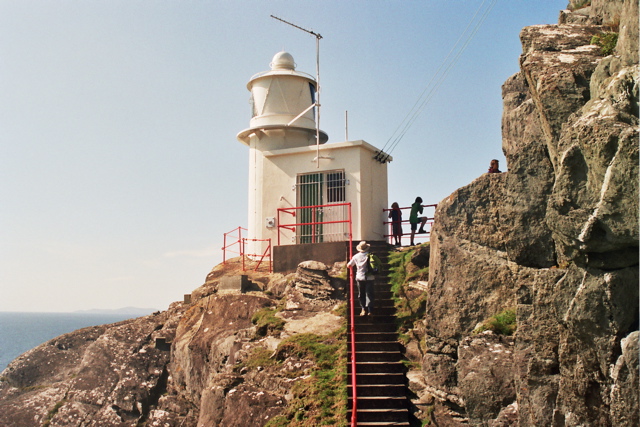
More properly Sheep’s Head is the name for the very tip of the peninsula, the few hundred yards or so of land that shoulder out into the Atlantic beyond the three houses of Toreen. Old maps show the tip marked with the name. The rest of it is Muintir Bhaire, but over the years the The Sheep’s Head has increasingly been the name given to the whole of the peninsula, more connected to the walk so closely identified with the place.
Muntervary, or Sheep’s Head, is a bold rocky headland, facing the Atlantic Ocean, which divides the entrance to Bantry Bay and Dunmanus Bay, and is the extreme western point of the peninsula of Mintervauria , otherwise Minster-Vauria, The House of the Friend of Mary. The signal tower at the Sheep’s Head is 774 feet above sea level. The rocky cliffs of this headland are exceedingly wild and grand during a storm from the west, when huge waves from the Atlantic are dashed against it with tremendous force – the spray from which descends a considerable distance inland, like a fall of snow. The eagle builds its nest in the Sheep’s Head cliffs, of which she has undisturbed possession; and many a hare and young lamb finds its way to the lofty and inaccessible eyries. Tourists who follow the routes pointed out in guide books have not the slightest idea of the grandeur and beauty of West Cork coast scenery.
A remarkable character formerly lived in the Sheep’s Head district, and is not many years dead. He lived to the great age of ninety-six years, and was well known for three quarters of a century as the King of the West. I have often conversed with him, and heard him relate how he watched, when a boy, the French fleet sailing up Bantry Bay. King Tobin, or the ‘King of the West’, although uneducated, was a very intelligent, shrewd, honest man. He was one of Nature’s noblemen. His son, the present King of the West, a P.L.G. of the Bantry Union, farms extensive tracts of land which have been held by his ancestors under the Evanson family, for generations.
The mountain range, which extends from near Durrus to the Sheep’s Head, and forms the backbone of the Peninsula varies in height from 600 feet to 1,049 feet above the sea level. Rosskerrig Mount, a little to the north-east of Kilcrohane, is 1,049, and South Killen, near Ardahill, is 1,029 feet above sea level. On reaching the summit of this mountain from Kilcrohane there is one of the grandest views in the United Kingdom; I doubt if there is anything to compare to it.
At your feet is that magnificent sheet of water forming Bantry Bay; to the west is the broad Atlantic, Dursey Head, Berehaven mountains, Castletown, Bere Island, the splendid and safe harbour of Berehaven, Rouncarrig Light-house, Adrigole, Glengariffe, Whiddy Island etc; while in the back ground you have Hungary Hill, the Sugarloaf, Esk Mountains, Magillicuddy’s Reeks, Mangerton etc, etc, the whole forming a grand panorama, with an endless variety of light and shade reflected on the mountains.

Turning around you have the view of another beautiful sheet of water, forming Dunmanus Castle, Three Castle Head, Mizen Head, Brow Head, Cashelenne, Mount Gabriel, and Cape Clear, filling up a bold, rugged and picturesque back ground. How many people, born within twenty miles of this delightful scenery, who have an idea that there is such a place as I have attempted to describe in Ireland. In the reign of Elizabeth there was an Act of Parliament which prohibited any person going abroad unless he had a thorough knowledge of his own country. Such an Act would, no doubt, be beneficial elsewhere. From a series of articles that appeared in The West Cork Eagle (the Skibbereen Eagle) in 1872.









 Sheep's Head Food Company