Naming fish

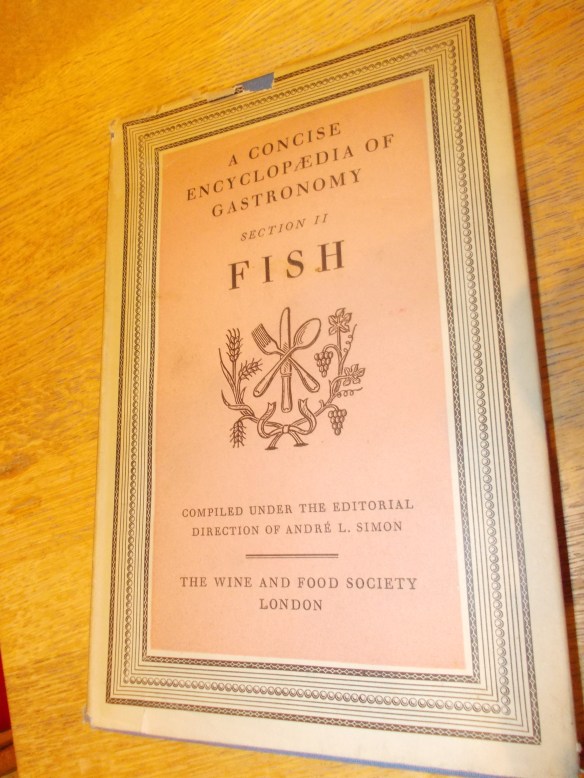
One of the small joys from doing some of your Christmas shopping in a second hand book shop is coming across the odd book that will do for no one else but you. So today I found A Concise Encylopaedia of Gastronomy Section II Fish complied under the editorial direction of Andre L. Simon and published in 1948.

DSCN2788

The first thing that caught my eye was the description of mackerel straight out of the water, they are quite stiff, opalescent, with bright protruding eyes and bright red gills. Beware of the limp mackerel. Which is indigestible always, and maybe poisonous.

Good advice. I then noticed some of the odd names for fish and thought it might form the basis for an occasional series. Here’s starting with A.

Alec An old Latin word of Greek origin (salt fish), which is used to refer to a herring or a pickle of small herrings.

Alewife Lat. Pomolobus pseudoharengus. A member of the herring family very abundant off the Atlantic coasts of North America and of great gastronomic value.

Atherine Lat. Atherina presbyter. Commonly known as Silverside or Sand-smelt. An excelllent little fish which can be dressed in any way suitable for smelt.

Listening to and very much enjoying Frank Ocean.

Fourteen lobster

_20_0314

On the moment I am reading Up In The Old Hotel by Joseph Mitchell. It is one of the best books I have read in a while. The book is a collection of the pieces he wrote for The New Yorker bwtween the 1930’s and 50’s. They are long and discursive, dealing with the people, the characters he meets as he walks the streets of New York and its environs. He gives the people time to talk about themselves and what they do. Some of these conversations are almost an aside to the meaning that he was able to find for their lives and their place in the city.

One of the joys of the book is the time that he spends to describe the waters around New York and along the coast up to Connecticut and the lives of the fishermen and the other boatmen who spend their time, and make their living on the sea.

One of those men is an Ellery Franklin Thompson, a Dragger Captain, a dragger is a small trawler. Mitchell describes him as about as self-sufficient as a man can be. He has no wife, no politics and no religion. Amongst other things he notices his trousers leathery with fish blood and slime…

Later this month I should be receiving the latest copy of Fire & Knives which should contain an article I have written about lobsters and fishing for them with Tommy Arundel. As a sort of celebration of that here is a description of how Ellery Thompson cooks and eats his lobster.

He is a matchless lobster chef. He boils and he broils and he makes lobster chowder, but most often he boils. He puts a tub of fresh sea water on the little coal stove in the cabin and heats it until it spits. He wraps his lobsters in seaweed and drops them in, half a dozen in a batch, and times them with a rusty alarm clock that hangs from a cop hook on the underside of a shelf above the stove; after exactley fifteen minutes, he dips them out. He lets them cool slowly, so the meat won’t shrink and become flavorless and rubbery, the common condition of cold boiled lobsters in restaurants, and then he heaps them on cracked ice in the ice bin in the forward fish hold. He and his crew – Frank, the mate, and Charlie, the third man – reach in and get a lobster any time they feel like it. They eat them standing on deck. They smack them against the rail to crack the shells, pluck out the tail and claw meat, and chuck the rest overboard. One fall day, out of the Hell Hole, the three of them ate fourteen in between meals.

Arundel’s Pub

25A_0396

One of the biggest changes we noticed last summer in Ahakista was the sprucing up of Arundel’s Pub. It is now being run by Paddy and Mary’s son Shane and his wife, Fiona. It still works as a pub and the fishermen are still there late on an afternoon drinking their cider and Murphy’s and the change still gets pushed over the wooden bar but all the lights are on now in the evening and the tables are full of people eating food.

_12_0199

Here is a small memory of a drink I had there one summers day a few years ago.

Mary – carefully pouring more pints of Murphy’s for me than I care to remember. In my mind some debate as to who pours the best pint – Mary or Paddy? Paddy’s pints are poured more slowly and he uses an old knife to tidy the pint, but Mary is more careful, paring off the foam at the top and giving the glass a gentle wipe with her fingers, passing it onto the drip tray for a minute before putting it onto a beer mat in front of me.

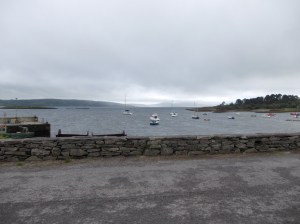
Mary and Paddy are the proprietors of Arundel’s Pub, fifty yards up the road and the trip that is usually taken two or three times a day.
DSCN0365

I had been to the pub and met a farrier who explained how it had been suggested to him that you could cook mackerel in the microwave. He had been sceptical at first but having tried it he said it was the perfect way to get the best out of their absolutely fabulous flavour. Put the gutted mackerel on a plate and put another plate on top and then cook it for 2 blasts of 2 minutes each. He said there was no better way of preserving the full flavour of the sea with the fish.
DSCN0861

The farrier had something of the Hwyel Bennett, in Malice Aforethought, about him, tight round glasses and an eager red face shaped around the glasses.

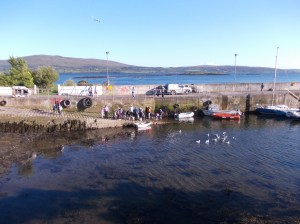
He went on to say that he had been fishing for mackerel off the pier at Union Hall some two weeks before and had been talking to someone and then heard someone else talk of how they cooked mackerel stuffed with rhubarb. He had wanted to ask how they did it but by the time he had turned to ask for the recipe the person talking about it was gone.

Talking it through with Mary he thought that perhaps rather than splitting the full length of the belly to pull out their guts a smaller hole was made and the guts pulled out through that. Pieces of rhubarb were then stuffed in the belly. He went onto suggest that perhaps this could also be cooked in the microwave.

That year I had brought with me to Ireland half a dozen sticks of rhubarb I had taken from the garden just before we left home. The original rhubarb plants had been bought a couple of years previously in pots from Bantry Market. I had made a rhubarb sauce to go with mackerel taken from Alan Davidson’s North Atlantic Seafood. So we talked on this and the cooking of gooseberries to go with mackerel.

There was then a brief discussion on the cooking of crab claws. They were good thrown onto an open fire and pulled out with a pair of tongs. Mary said that scallops could be cooked the same way, whole in their shells, and they cook in their juices. She will only do 2 at a time when she is able to get them from the fishermen who take them out of the bay between November and March. They are placed on the fire whole in their shell, curved side down, flat on top, so the juices are caught in the shell. The flavours are beautiful.
_11_0037

The farrier then talked of how his grandfather had salted mackerel, splitting them on the bone and laying them flat in a plastic barrel and covering with coarse salt, layer after layer, put aside for 6 weeks and then all liquid being poured off and then being re-salted, after the barrel had been cleaned. Left for three months before more salt was  added and left again until ready to be eaten. The salt purged the blood and badness from the fish and the third salting was necessary to make sure that no blood should be left to rot away at the fish. Left like that salted mackerel had fed people for hundreds of years.

Small mackerel are better than the big fish, he said, and I think there is some truth in that. On a big fish the flesh can become heavy and solid. The smaller fish are lighter to eat and I would say it is easier to eat down 3 small to medium sized mackerel than one big one. One big mackerel is very much a meal in itself whilst a few smaller ones will do for a snack.

I asked him how best to cook pollock and was told to wrap it in foil with butter and flavouring; salt and pepper, and then leave it to bake in the oven. And with that he was gone, slipping into his black van parked on the gravel outside the pub and off up the peninsula. Mary confessed that she had not met him before and did not even know his name.

A RHUBARB SAUCE FOR MACKEREL

Not really a recipe, more an application of common sense.

You will need a pound or so of good rhubarb. Chop it up finely and put in a pan with a drop of water and a tablespoon of sugar. Squeeze in lemon juice and allow to simmer until the rhubarb has collapsed. Use a wooden spoon to push the rhubarb through a fine sieve. Taste for sweetness and add more sugar if needed but remember you will need it sour to cut through the oil of the mackerel. Eat with fillets of mackerel lightly fried in flour.

DSCN1266

Beet stained salmon

Earlier today I stole a couple of hours out in the garden, cutting back the buddleia in the wall, clearing out the beds clogged up with leaves and dead growth and finally emptying the greenhouse of the slightly disappointing tomatoes. Before I started I sawed up a bagful of logs for  the fire. I keep thinking I need a chainsaw for this, then last week I read the poem Galen is going for his English GCSE, Out Out, by Robert Frost about a boy sawing wood who is distracted by his sister’s call in to dinner and loses his hand. Given the damage I have done to myself over the years with just an ordinary saw I am probably safer with that.

DSCN2770

Grubbing around in the beds I found the emerging shoots of next Springs growth although there was no sign of the hundred or so Snowdrop bulbs I planted earlier in the year.

Back inside I started on making some Beet Cured Salmon for the next meeting of the music group on Thursday evening.

DSCN2762

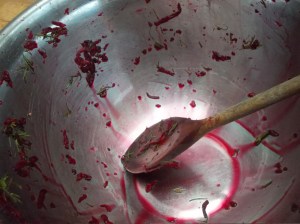
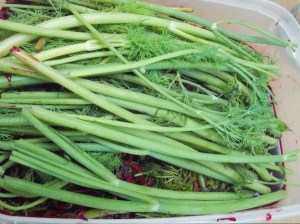
There is a perverse pleasure in grating raw beetroot watching your hands stained blood red by the ineluctable juice. The grated beetroot was then mixed with a good handful of salt and sugar, chopped orange peel, crushed pepper corns, a glass full of vodka and a great bunch of dill.

DSCN2764

Half this mixture was spread on the bottom of a plastic container, a skinned salmon fillet was placed on top, and the rest of the mixture was spread over. I laid the stalks from the dill on top and then weighted it down. My best weight is a lump of pig iron taken from an old lawn mower that was heading for the tip. That all went into the fridge for two days.

DSCN2765

We will eat with creamed horseradish from the garden. I pulled out two crooked roots this afternoon. I suspect that next year it will be out of control and will have taken over its corner of the veg patch.

DSCN2755

This evening I have been making more quince paste.

DSCN2753

They are in the big pan on the oven having been boiled for three hours in water until they collapsed and then through two sieves and mixed back with almost its own weight in sugar.

DSCN2778

Jane Grigson in Good Things  suggests that at this stage, when stirring, you should wrap your hand in a tea towel before taking the wooden spoon so the molten hot sugary paste doesn’t spit at your skin.

Late lunch/supper was roast chicken in goose fat, carrots with honey and cumin and roast potatoes. The oven was full for a while.

DSCN2776

Listening to Bill Callahan’s Apocalypse – his slow taking apart of the spaces of the Old West.