It was a bloody business and one writer in Blackwoods Magazine about 1870 saw it was the fish-wife’s revenge: “When gutting is at its height their hands, their neck, their busts, their “dreadful faces thronge’d, and fiery arms”, their every bit about them, fore and aft, are spotted and besprinkled with little scarlet clots of gills and guts. A bob down to slice a herring and a bob up to throw it into the basket and the job is done. These ruthless widows seize upon the dead herrings with such a fierceness as almost to denote revenge for their husband’s deaths – victims of the herring lottery – and the widows scatter about the gills and guts as if they had no bowels of compassion”.
Business in Deep Waters
You need a sharp knife and be prepared to get your hands bloody.
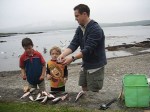
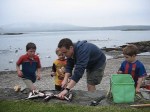
It is best to do this by the rock pools down by the beach. They are perfect for washing down the fish once you are done and well placed for the seagulls that will start to gather a minute or two after you start.
Take a fish in your left hand belly up and head pointing away from you. Put the point of the knife in the small hole towards the tail of the fish, properly known as its vent, and when the blade has torn the skin move it gently with a slight sawing motion towards the head, slitting open its belly until you get to the pectoral fins beneath the head. Take the knife carefully between these fins pulling it out just before the gills. As you are doing all this be careful not to go too far into the gut cavity.
With your fingers draw out the guts, ideally in one ferreting motion, from the head back down to the vent, making sure to take everything out, then push your thumb hard up against the back bone and run it down forcing against the nail the black line of blood that lies there and clearing out any residue of gut. A Guide to filleting mackerel produced for the Billingsgate Seafood Training School tells you not to use your bare hands for this and to put on surgical gloves. But you will be on holiday, flush with the success of your catch, there will be a pint to hand and your hands should already be bloody from the killing of them in the boat. You can always clean up in the sea.
It can be instructive to take a look at what you are pulling out. Mackerel are indiscriminate eaters cruising the dark waters mouth wide open, all part of one vast pack, taking in plankton, sprat and baby squid. Sometimes as the bloody gob of gut lies in your hand they can be seen undigested and perfectly formed as if they had only been taken from the sea a few moments before. Look closely and the sprat maybe a baby mackerel, only an inch or so long but otherwise the perfect copy of the fish you are holding in your other hand, its tiger stripes and colour still vibrant back in the sun-light. This last year as a line of mackerel was spilling into the bottom of the boat one of them hawked out a small sprat its skin abraded by the sharp teeth of its devourer.
Throw the guts for the gulls.
You may have to wait a minute or two before they realise you are there. But one will be flying on its determined straight line out to sea and will swerve off course when it sees you, or another will catch what is going on from its perch on one of the lights on the pier. Rather than keeping the news to itself it will hawk back its head and broadcast a triumphant cry to all and sundry that there are guts to be had and soon there will be a dozen or so circling overhead ready to take their fill from the water, the air filling with the sound of their bark and bray, the birds reeling up and then down in a rush to the water, sharp yellow beaks snatching through the flurrying wings before pulling away. If one has been particularly greedy it will be chased on its way back to Owen Island and if inexperienced forced to cough up its meal back to the sea for it to be gobbled down by its stronger pursuer.
Wash out the fish in one of the pools making sure you get ride of any residue of blood.








 Sheep's Head Food Company