From Copenhagen to Cadiz

The eldest daughter is off to Copenhagen next most month and has managed to snaffle a seat at Noma where she will be eating some of the best food in the world.

I mentioned this to somebody the other day and was told that I should watch an episode from Rick Stein’s last series in which he spent a weekend in Copenhagen. So I settled down to watch it Friday night.

The bit about Noma was an anti-climax as someone had got something wrong with the booking and there was no filming inside. All we got were a couple of shots of an impressive looking converted warehouse with the Noma sign outside.

But there was plenty of other Noma like food a lot of which was assembled on plates with tweezers and patience. For all the impressive cuisine the best looking food that I saw was on open sandwich served in what looked like a fairly prosaic cafe – rye bread piled with pickled herring, sour cream, salad, apples and interesting tasting green herbs.

But as I watched the programme my mind kept turning back to the opening credits showing the various places Rick had visited over the course of the series and a shot of what  looked like the cathedral in Cadiz. Halfway through I could take it no more and I turned off the programme on Copenhagen to try and find if he had devoted an hour long programme to the good food that can be had in Cadiz.

It turned out he had and I was hooked for the next hour.

If I have a favourite city in the world then it is probably Cadiz. I have been there three times and on each occasion totally beguiled by the place.

The first and second time I was there we stayed by three or four days and the last time (5 years ago) we were there just for the day.

Cadiz is a big city that stretches across the coast facing up to the Atlantic. The old city is almost totally surrounded by the sea and is at the end of a long spit of land that sticks out into the ocean. The port area is relatively modern and most days there will be a cruise liner hogging the horizon but it doesn’t take much to step back into the old city.

It is mostly made of narrow streets, the roads just about wide enough for a car, through which it easy to wander trying to get lost until inevitably the street opens out to a square where there is normally a bar to be found selling cold beer, sherry and tapas.

The streets are narrow to give some protection from the sun in the high days of summer when the heat beats down so it is impossible to do anything. On either side there are tall houses with big heavy doors and oversized knockers. Occasionally a door will be open and walking past you slow down to look into the cool shadowed interior. A lot of the houses have a small central courtyard open to the sky with a pool or fountain in the middle.

All the buildings appear to be made out of faded yellow sandstone. The permanent sea air weathers the stone and it can feel as if the whole city is slow crumbling back into the sea that always there around a corner as you walk.

But as Rick Stein shows it it is the food that makes the place.There is a fish market in the centre of the old city. Walk through it on a morning and the white slabs of cold stone are loaded down with obscene amounts of fresh sea food. It is difficult to believe that the sea can keep giving of its bounty so that Cadiz can continue to have its fill.

Of course with a market like that seafood that can be had in every cafe, bar and restaurant is pretty special.

The last time were there was a Sunday. The bars and the tables and chairs spilled out in to the street all with people drinking and eating and talking.

We sat inside and ate great platefuls of fries fish; dogfish flavoured with vinegar, small whole squid and best of all tortillitas de camarones – small whole prawns cooked in batter with a few green herbs.

Later in the afternoon the tables and chairs were put away. They would be out again in the evening.

Watching Rick Stein walk the streets of Cadiz the hairs on the back of my neck bristled and I could think of no other place I would rather go back to.

Milleens

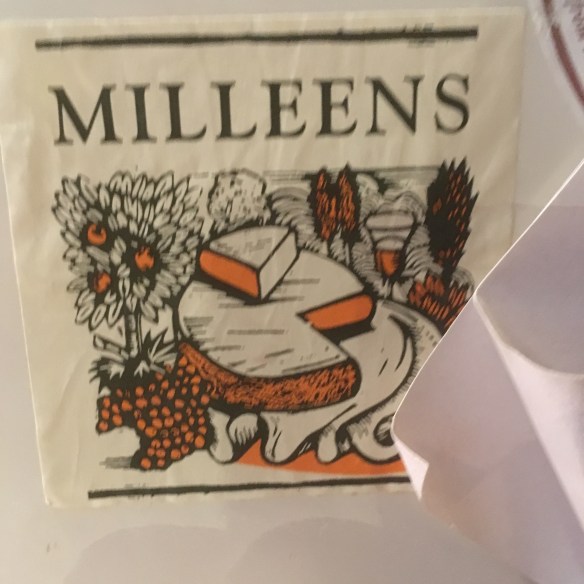
One of the great pleasures of going to West Cork every summer is the cheese. Durrus and Gubbeen are always readily available but Milleens is a bit more elusive. Tt has to be furtled for on the shelves of Super Valu in Bantry and Schull and on the tables that are set up in the regular markets.

img_1461

But it is one of my favourites especially after it has been left for a while in the back of the fridge and is then found again. If I make it for my sandwiches for lunch there is deep smell of the earth and matured green grass that sticks to my fingers through the morning.

So it with some sadness that I read that Veronica Steele had died. She started making Milleens back in 1978 and in many ways can be regarded as the god-mother to all the great cheese that can now be had in Cork.

This is what Jane Grigson had to say about her in 1984 in an article that appeared in The Observer Food Magazine.

VISIT TO A CHEESEMAKER

Thinking that Ireland was short of cheese, I brought one over from T’yn Grug for the Allens at Ballymaloe. They were politely grateful, but I need not have bothered. Their Sunday evening table was covered with Irish cheeses. Later in Dublin, in the cheese shop of the Powerscourt Townhouse market, the first thing I saw as I walked in was a row of them – cheese from Milleens; soft goats’ cheeses from Wendy and Brian Macdonald in Wicklow and so on.

We went to visit Veronica and Norman Steele on the north side of the Beara Peninsula at Milleens. Rhododendrons and thick greenery at first, pines and glimpses of water. At Dareen gardens, a coast road turns off right down past the cottage where the fish producing O’Connors live. A creek runs in at that point, a path goes down to their boat and in the distance their shellfish rafts rest on the sea; we thought of dinner to come at Kenmare, with their mussels, their oysters and, above all, their sea urchins.

On to Milleens. A flaming car in the middle of the road watched by the sad owner and his parents. No one in sight, village two miles away. Gradually people emerge from nowhere, ambling along, chatting, drawn to the smoke and flames. At last, we get by.

We struggle up the right stony muddied lane and we find two philosophers in Wellington boots, teacher and pupil, both young, turned herdsman and cheesemaker and not regretting it. Straight off the lane, you step up into the orderly, sweet – smelling cheese room, the dairy. Then into the living – room where cheeses were set out on a long table, with a long bench and a view over the sea, over the great inlet like some Galician ria that jags in to the town of Kenmare on this rough shredded fringe of Ireland.

The Steeles began in 1978 with one cow, three gallons of milk a day. Now they have twelve friesians, two kerries and fifty gallons of milk a day. They make two kinds of cheese, Beara which is a cooked curd cheese, a big yellowish cheese, and the flatter Milleens. They export all over the place, to Germany, America and England. With one helper, they have a business they can manage, a life they like – but they could sell ten times as much.

They are keen to spread the idea of Irish cheese. With the chairman, Patrick Berridge, they are amongst the most active members of the Irish Cheese Producers’ Association, which is now thirty strong. Veronica Steele has no craft secrets, but passes everything on that she can.

A last supper

The house is now a quieter place. The eldest two children have gone back to university and the rest of us need to fall back into a different rhythm.

There are of course advantages, the likelihood of being swept up into a bear hug by the nineteen year old son are substantially reduced and the general level of screeching has been reduced.

The final family meal was Friday night. I had planned a feast of falafel, lamb, pitta and miscellaneous tapas but was told that one of our number didn’t like falafel, never had done, and I would think again.

So I suggested beans with guacamole, fried chicken, wraps and tacos. This got a more positive response provided the beans were better than the ones we had for a Sunday breakfast in Brighton a couple of months ago. I hadn’t had the beans but I was told this would be a tall order.

I started with the beans. I cribbed part of the recipe from the  Brindisa book on Spanish cooking I was given for Christmas.

An onion was finely chopped and cooked off in olive oil until soft and golden. Crushed garlic and chopped chilli was added together with a large roasted red pepper, also finely chopped and finally a fresh bay leaf. Once all that had taken on some colour a couple of tins of chopped tomatoes were stirred in and it was all brought to a simmer. I then stirred in three tins of haricot beans and seasoned it all with plenty of salt, pepper and paprika. It was a left to cook for an hour so whilst everything was put together.

Chicken breasts were put on to fry in oil with salt, pepper and more paprika. As they cooked in a sliced onion and pepper were thrown in. Once the chicken was done I sliced it up and stirred in some Mole sauce (a Mexican chilli sauce made with chocolate) at which point it seemed like a good idea to stir a teaspoon of the Mole sauce into the beans. I loosen the chicken up with a glug of beer.

Finally I made the guacamole. Four avocados were mashed with a wooden masher. A finely chopped red onion was stirred in along with chopped tomatoes (if I had been doing it properly I should have skinned a deseeded the tomatoes – but most days I think life is too short for the skinning and deseeding of tomatoes), crushed garlic, chilli, lime juice, olive oil, a dash of tabasco and more salt and pepper.

We ate it all with wraps and tacos, grated cheese and salad, hot chilli sauce and cooling yogurt.

The kids seemed to enjoy it although I never got to hear if the beans were better than the ones we had in Brighton?

Once the food was eaten they started on the packing for journeys down south.

A curious Christmas

So that was a curious Christmas and probably the first completely sober Christmas Day that I have had for the best part of the last 35 years.

I should probably start by saying ‘thank you’ to the doctors and nurses who were working in the walk in centre in Arrowe Park and so were able to see me on Christmas Day and prescribe me the antibiotics I needed to keep me a few steps further from death’s door than I might otherwise have been.

It was surprisingly quiet up there.

I guess most people feeling ill were staying at home in the hope that a further 24 hours would see them through. I had been of that camp until around midday when I attempted to shuck an oyster and found myself shaking so much there was greater chance of me removing a finger than the oyster being shucked. A GP friend was duly consulted by way of telephone. He was able to supply a medical name to the shakes (‘the rigors’). Apparently these combined with the periodic hot flushes I was also coming down with were signs that a serious infection was about to be unleashed somewhere inside me.

So off to Arrowe Park we went.

There was some initial confusion on being called for the nurse. There were only three people sat waiting to see someone but it transpired that at least two of them were called Ralph. So when my name was called I found myself in competition with a three year old and his anxious parents. The confusion was sorted and the three year old was sent back to sit down.

The nurse took a long list of details, gave me a small plastic container for ‘a sample’ and suggested that it would be another few hours before I would be able to see a doctor but in the meantime the most important thing was that I produce ‘a sample’.

Unfortunately I did not feel in any desperate need to produce a sample so I positioned myself next to the water dispenser and drank my way through about three pints of water. There was still no stirrings of a sample but I was called back to see the nurse. A doctor could see me later that afternoon. In the meantime there was no reason why I could not go home but I would have to come back with the sample.

So we went home for an hour or so to watch some more presents being opened.

We were back there at 5.00 having left instructions at home for the final preparations of the food so it would be ready by the time we were back.

I saw the doctor. There was more confusion. He was hard of hearing and I was not speaking clearly. So when I explained that I had suffered from a urinary infection before Christmas he expressed some surprise that I should be there on Christmas Day for an ear infection.

Confusion cleared up he tested the sample and duly prescribed more water and the necessary antibiotics and we were back out after only half an hour.

At home they had not been able to wait any longer for food and a large part of Christmas dinner had been eaten by the time we got back.

I had a roast potato and a slice of the capon by which time I was ready for bed.

So Christmas passed in a blur of sobriety and the slightly hallucinogenic effect of whatever infection was passing through me.

In the meantime we did a few walks, I made a particularly good bolognese sauce and there was a general sense of relaxation.