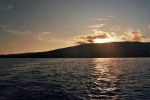
There is no feckin’ weather like the present

The man took a hold of my arm and squeezed it hard.

‘There’s no feckin’ weather like the present. It may have been raining yesterday but if the sun is out tomorrow then what does it matter and if it’s raining today then all there is for it is to get wet with it and be damned for it.’

It was raining outside and the wind had taken a hold of the weather and it bore down on the ground.

He squeezed my arm again and then let go to take up his pint.

‘The weather here it can be as fickle as the fish are on a hot day in August. You’ve seen it come in on a day when there is not a cloud in the sky and it starts with a mist that rises up the bay and it comes in over Carberry Island and soon it is up here and the sky has gone and there is thick wet rain in the air.

‘And it is the weather that does it for people when they come here the first time. Arrive on a day when it is damp and thee is a breeze coming in off the water that is enough to force that dampness down the back of your collar then you’ll be buttoning up your coat to get back in you car and away from here. But come on a day when the sun hangs lear in the sky and you can see the light come in off the water then you’ll be stuck with the place and you won’t want to move no matter if the next day the rain is coming down like so many badly tuned pianos.’

DSCN6051

Bait Ball

It started with half a dozen gannets wheeling over the centre of the bay but rather that circle for a few minutes before making their dive to the water they flew back up to the appropriate height and came straight back down again a quick white flash and splash. Black shapes heaved in the water around their dive-bombing. It was a school of about thirty porpoises and it was obvious that the gannets and the porpoises had come across a feast of mackerel and sprats. The number of gannets grew to a dozen and the porpoises rolled and turned in the sea heads surging up out of the water and then back down with a flick of the tail churning the water.  Some of them breached their whole body rising up out over the surface and slipping below the waves. The feasting lasted about ten minutes before the gannets separated and moved further up the bay followed by the porpoises showing themselves just by the arc of their dorsal fin cresting the waves.  They left behind with the remains a collection of cormorants that bobbed like so many black sticks in the water.

In a good year the days will dissolve into a blur of light, sea and air. Slow mornings waking up and testing the weather. Opening the curtains to see how the tide has shifted from the previous day and to check the scud and slip of clouds across the bay. Downstairs to open curtains and make tea ready for breakfast, either on the plastic green table and chairs outside the yellow door or on the table inside watching the rain and wind scuff at the concrete on the pier. The unpredictable cut of the weather makes making plans a nonsense and most days breakfast ends with our deciding to see how the weather plays out before we make a decision on what to do and of course that is no decision at all. There will be a chance to jump off the pier, to go crabbing or to root around the seaweed, book of wild seafood in hand to catch what lurks there. And if the weather and tide is right a chance to ride out to the point off Owen’s Island to see if there are mackerel about for lunch. At this point it clear there is no time for us to be going anywhere for lunch and so this meal is going to be had at the Cottage. There will be a small mental tick to make sure there is enough bread and perhaps some sausages to make do. If mackerel are caught then that is all to the better. Turning to the early afternoon then if it is dry a fire should be made on the beach.  There is always a vague hope that a child will bend to the task, but children turn so quickly into unyielding teenagers it is a hope that goes unanswered so there is a chase for driftwood to make up kindling and 10 minutes or so patiently spent with screwed up pages of yesterday’s Guardian and matches to get the fire alight. Once alight it needs to be carefully constructed to be capable of cooking food. We have a good grill now but this is not always enough and if the wind is on the beach there is a need to construct a wall of bricks around the fire so that sufficient heat is directed at the grill to cook the food.

Five days later we could see more than fifty gannets circling the sea just off Owen’s Island. I had not seen so many in the bay before. As one went down two or three others would follow and there would be a silent thump as each hit. Sometimes the movement of the fish under the surface caused them to swerve at the last moment careering off at an angle before breaking the surface. Moving closer we could see that after they went under there was another small eruption of glittering foam as they came up again shaking their feathers. After a moment on the surface they would pick up their wings and go back to their natural element the air pattering the water to get sufficient lift. Some of the mackerel we caught were the largest we have had out of the water at the Cottage. They had also been gorging themselves and their bodies were still and bloated with the sprats they had eaten. Some were vomited out as we removed the hooks. As we gutted them on the black rocks at the garden they seemed to deflate slightly as the knife moved up their belly and out with the guts would spill sprats that had been swallwed whole their skin maked with small abrasions made by the makerels teeth. We threw these sprats to the gulls along with the guts and there was of course an irony in the small fish being eaten twice in the same day.

A slow Sunday

Last night we had a nineteenth birthday party in the house. So at 3.00 o’clock this morning I found myself being rude about Pink Floyd (“God, I love Pink Floyd”?!) and looking out obscure Velvet Underground tracks in order to impress the teenagers. I tried them out with a bit of Goat but they weren’t convinced.

And so that took me back to me being nineteen and the parties I used to go to where there would be a DJ with a couple of record decks and a box full of records and there would be a time for sitting on the floor and pretending to row to The Gap Band singing ‘Oops  Upside Your Head’ and then sidling up to the DJ and trying to get him to play something good – mostly either Jimi Hendrix or The Doors.

After all that. today has been a slow day. Most of the bottles were cleared away last night and there was not much mess to clear up. There were, however, a whole bunch of stragglers here for breakfast who managed to eat most of the bacon I cooked before I was able to get to it.

The sun came out this afternoon so I took the time to go outside and start on the tidy up of the greenhouse. This involved sweeping up all the old bits of soil from the floor, re-stacking the plastic pots and throwing away the collection of seeds packets that has been mouldering in there for the last year or so.


More on the history of mackerel…

From Kettner’s Book of the Table.

DSCN8935

A great authority, Grimond de la Reynière, says: “The mackerel has has this in common with good women – he is loved by all the world. He is welcomed by rich and poor with the same eagerness. He is most commonly eaten à la maître d’ hôtel. But he may be prepared in a hundred ways; and he is as exquisite plain as in the most elaborate dressing” (au maigre coome au gras). This immense praise, and is a complete justification of the common English method of serving him  – plain boiled, with fennel or with gooseberry sauce. Nevertheless I give my vote to those who assert that there is but one perfect way of cooking a mackerel – to split him by the back, broil him, and serve him with maître d’hôtel butter. Still better, take his fillets and serve them in the same way.

The name of mackerel is supposed to be a corruption of nacarel, a possible diminutive of nacre – from the blue and mother-o’-pearl tint of skin. In one of the dialects of the south of France he is called peis d’Avril, the April fish – or as we should say, an April fool, both because he is a fool coming easily to the net, and because he first comes in April. He is not only quickly caught, but he spoils so quickly that the law accords him a peculiar privilege: he is the only fish that may be hawked from the street on a Sunday. For the same reason he is the only fish besides the salmon that is much soused or marinaded in the country.

The mackerel which comes to our shores is a great puzzle to the philosophers. He has no air-bladder, yet he is as buoyant and lively as fish can be. What then is the use of an air-bladder?

DSCN0285