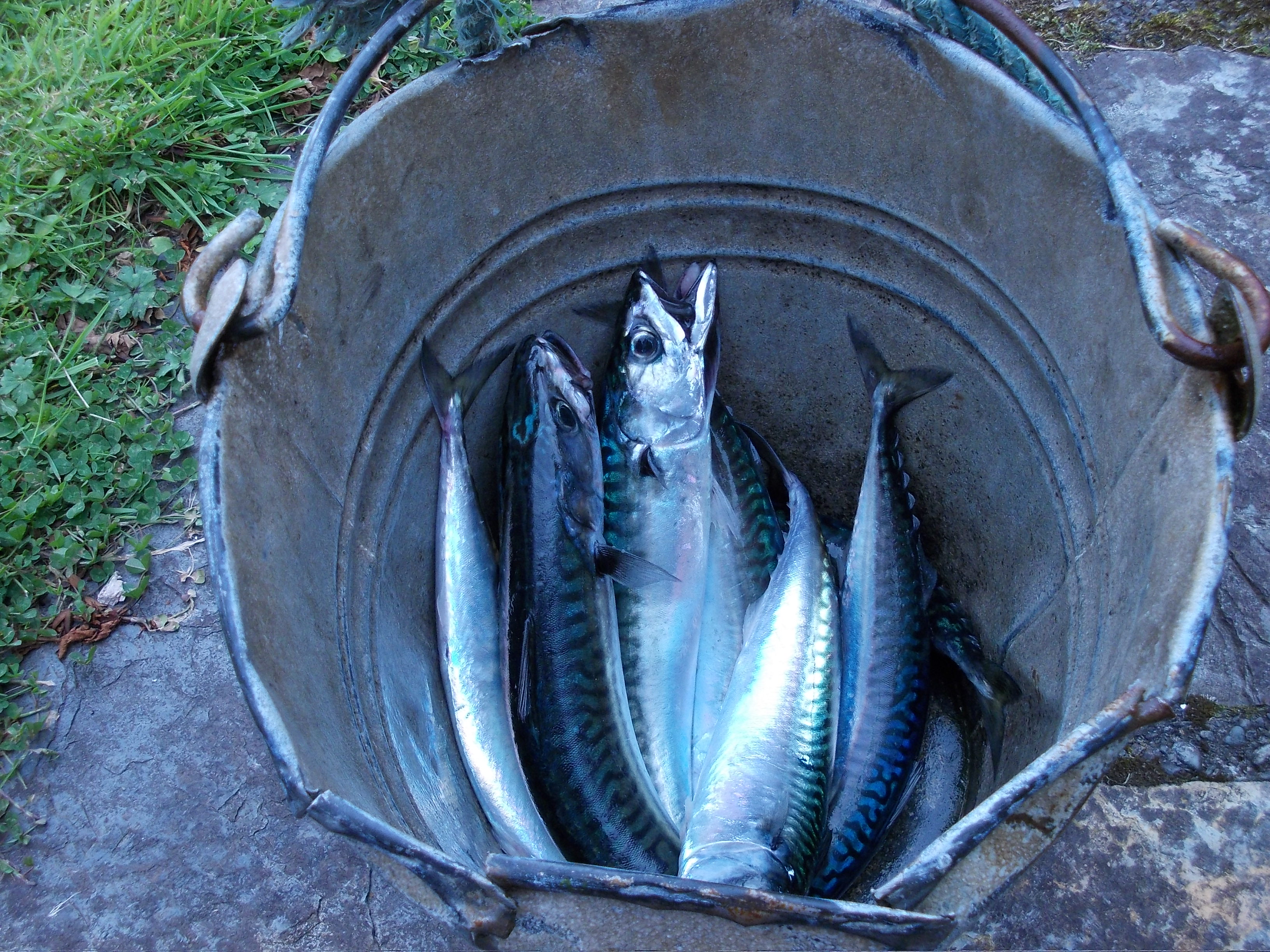
Some of the history of mackerel

Read any book on fish and mackerel come a poor second to the herring. Although they swarm in unimaginable numbers they have never created boom towns in the way that herring have turned obscure fishing villages into small versions of the Klondyke and at times generated industries that for their time and place compared to the importance of North Sea Oil.

Mackerel spoil too quickly. Its price has depended on its ability to get from boat to shore and then to market in time for it not to have lost the freshness and taste that make it potentially the best of fish. Otherwise it has to be salted and there has only been a limited market for that. There has also been an unpredictability in its whereabouts. Although it might always be there year in and year out its surges have been more susceptible to the vagaries of the wind and weather.

Its lack of staying power has set it apart from other fish. When Billingsgate was declared a free fish market six days, a week, permission was given, by William III in 1699, for the selling of mackerel on a Sunday leading to complaints from John Gay, writer of The Beggar’s Opera, that Sundays were being profaned by the cry of mackerel sellers.

On the coast of Ireland, the Mackerel is taken from the county of Kerry in the west, along the southern shore, eastward to Cork and Waterford; from thence northward toAantrim, and north-west to Londonderry and Donegal.

The same article from a magazine called The Saturday Magazine describes the number of fish caught from Brighton and Dover and describes how in June 1808 the shoal of Mackerel was so great, that one the boats had the meshes of her nets so completely occupied by them, that it was impossible to drag them in. the fish and nets, therefore, at length sunk together. At that time the boats engaged in fishing, are usually attended by other fast-sailing vessels, which are sent away with the fish taken. The magazine dates from August 1835 and describes how the fish were taken up overnight to London in vans.

Twelve years later a similar article appeared in The Illustrated London News describing how the mackerel were taken in great abundance from every part of the coast in spring and early summer. They are conveyed by rapid land journeys from the coast to London for sale; and, for the encouragement of the Mackerel and other similar fisheries, the carriages in which the fish are thus conveyed are exempted from post-horse duty. However, this measure is now almost nugatory, from the greater rapidity of railway transport.

Contrast these two articles with what was going on in Ireland at the time. The methods of fishing as described by Yarrell and the quick journey to town for the fish to be sold. The boats available in Ireland and what must have been the difficulties with transport – go to the Somerville book and its description of the isolation of a wife coming to outside of schull and the difficulties with transport.

As the first shoals move inshore they are a harbinger of spring announcing the imminent arrival of other species moving to the shallow warm soup of sea fat with food. They have even lent their name to garfish that were once known as ….so common was it for the arrival of the spring mackerel to be followed by the garfish.

In 1819 the land West of Schull was entirely cut off from the rest of the world.  Sir John Moore had desribed it as “wilder than anything I have seen out of Corsica”. There were no proper roads. When Pococke had toured in 1740 he had found that the only reliable way to travel was on horseback with outriders tp protect him from dangers. In 1819 there was one boggy track connecting Ballydevlin with towns to the east, and this was so bad that very few carts made the journey.

Compare with the south coast of England and the roads and shortly to be built railways that allowed for the fast transport of the fresh fish to their ready market where there was an eager population prepared to pay for their fish.

Ireland was still struggling to rise above a sort of subsistence living and the increase in population and the dehabilitating system of land tenure pushed people back to only being able to look for themselves and their master or landlord. Fishing was there to supplement the diet when available.

The mackerel of the Mediterranean, however, are poor and tastless, compared to those of the Atlantic, and though Apecius wrote many receipts for sauces to dress them in, and to pour over them at table, it is certain that the ancients hardly considered them fit to eat fresh, but preferred them salted, as the Spaniards do to this day. The physician Celsus, eighteen hundred years ago pronounced them very heavy food, – gravissimum alimentum. Oppian, a Greek of the second century, who wrote a long poem on fish and fishing, compares the mackerel’s fondness for brilliant colors and his readiness to bite at a bit of red rag, to the rashness of the infant playing with fire:-

“Just so the little smiling boy admires

The candle’s painted blaze and curling spires;

Extends his hand, but dear experience gains,-

The greatest beauty gives the greatest pains.”

As the fish soon become unfit for food, the mackerel dealers have been allowed, since 1698, to cry their commodity for sale through the streets of London on Sunday.

In May, 1807, the first Brighton boatload of mackerel sold at Billingsgate market for forty guineas a hundred, or nearly two dollars for each fish. On the other hand, they were so plentiful at Dover in 1808 that sixty were sold for a shilling. At Brighton in June the same year, the quantity of mackerel in the water was so great that the fishermen of one boat could not drag in their nets, but had to let nets and fish sink together

We may further remark of the Mackerel taken early in the spring, that they often differ in quality according to the season and place, a circumstance which may with much probability be ascribed to the variety of food they chance  to meet with in their widely-extended excursions. In some parts of the Mediterranean they are described as being always small and dry; and such appears to have been the case in ancient times at Rome, where, in their fresh condition, they were disregarded. As they were sold by fishmongers wrapped up in paper which was fit for no other use, a sarcasm was directed against inferior poets, that their works would be applied to the use of wrapping up Mackarel. Risso, on the other hand, praises the Mackarel taken at Nice for its superiority of size and flavour; but we believe that in no districts will any be found to excel, and few to equal those which visit the west coasts of the Britsh Empire.

In the 19th century mackerel was of considerable commercial scientific importance but by 1926 the importance of mackerel had declined. Why?

As herring stocks in European waters went into decline in the 1960’s commercial interest in mackerel started to revive. This interest intensified as declining stock abundance led to am almost total ban on herring stocks by the mid – 1970s. exploitation of the European mackerel stocks intensified further as distant water demersel trawkling fleets were displaced from their traditional fishing grounds following the universal adoption of 200 milw fishing limits throughout the N Atlantic.

In the 19th centuary the mackerel was a highly valued species. The first of the season landed at Brighton in May 1807 were sold in Billingsgate Market, London, for seven shillings (£0.35) each, which is about £30 in 1885 value!

DSCN0285

Making the best of a pork chop

Sometimes all this is supposed to work as an aide memoire. So if I cook something good then I can make a note of it here and next time I am presented with the same ingredients or whatever I know where to look to find what to do.

It never works like that. There is no cross-referencing or logic to what goes on here and no real way to find my way back to what I have written. So I end up putting myself into Google with some words that I hope will approximate what I am looking for and hoping that something right will come up. So I know that some months ago I made a particularly successful curry and it came from a particularly recipe but there is no recollection of it other than that. I am fairly sure there would have been some mention of it on here that would give me a clue. Still doesn’t work.

Anyway this evening I cooked some great pork chops. Mostly pork chops are a disappointment but these came out fine.

The cooking of them took some inspiration from the partridge I cooked for myself last Friday.

It started with half a dozen old potatoes that were still covered in dirt and had started to sprout. I peeled and cleaned them off and then cut them into rounds about a quarter of an inch thick.

These rounds were then browned in oil in a heavy baking dish. They stuck at first and needed a sharp touch with a wooden spoon to loosen.

Once they had taken on some colour and had been turned a few times the chops went on top along with a finely sliced onion, garlic and plenty of salt and pepper.

The dish then went into a hot oven for half an hour.

Eating it I think the rounds of potato had taken on more from the cooing than the pork chops. They were soft on the inside and crispy and had taken on a sweetness from the onion and the juices that had leached from the chops.

It was a son and dad meal and we both left our plates clean.

.

Counting mackerel

Have you ever thought to do the mathematics?

How many years have you been coming here now?

So that is fifteen summers you have been here and when you are here you are here for more than two weeks and in those fourteen days how many times are you out catching fish?

Feck there are days I’ve see you go out more than the once as if you are trying to catch up on yourself. And I know they are a fickle fish and you are not going to catch a few every time you go out but most times there will be at least one on the line.

So we can say that over your fourteen days you might be out there on at least seven of those days catching fish. So how many fish do you catch when you are catching them?

There will be times you are out there by yourself and you take twenty minutes to have forty of them in the bottom of the boat. And then there will other times and there are four or more of you in the boat, some of them children, and there are three lines over the side and you are swapping them round so all can have a turn and the feckin’ things get caught up and tangled. And then if you catch a fish there is such a squeal of voices that the fish left down there in the water will feck off back down the bay and all you are left with is the one fish and your tangled lines and disappointed children

Now if we cut those numbers in half that makes an average of twenty fish that you catch when you go out there over the course of your seven trips. So that is one hundred and forty fish you have out of the water over your summer. And you have done that fifteen times so that is two thousand one hundred fish you have taken out of the bay.

And over those fifteen years has there been a day when you have missed out on a trip up here to the pub? That being the case shall we do the mathematics on your good pints?

DSCN0285


The trouble with horseradish

Better weather so I have been out in the garden. I should have left the planting of the primroses until today. When I did it yesterday it was in thick and heavy the rain.

There is still some wind today but no rain and there patches of blue sky and if the sun were to come out it could almost feel warm.

It was a week or so later into the year last February that I wrote about the fifty snowdrops I planted and my worry as to whether they were going to flower. Some of them are out already and from the kitchen we can see the small white bells under the apple trees. More of them seemed to come out whilst I was outside.

On going outside and into the garage to fetch a fork I was faced with the question as to how the large road sign got in there. I suspect that the answer is currently in Paris but I will need to wait a couple of days to find out.

In the veg plot I pulled the last half dozen or so small beetroot that were left in the ground. The cavolo nero is still going strong so I will leave that in for another few weeks. I cleared the other beds and dug them over. The biggest problem appears to be the horseradish I planted a few years ago. It seemed like a good idea at the the time but the roots spread under the ground  and last summer we had horseradish coming out of the ground in odd spots. As you pull the roots from the ground they snap easily and each bit will potentially take if it is left in the ground. I did the best I could and every so often the sharp smell would catch at the back of my nose. I put all the pieces of root back in the ground near the compost bin. It would be shame not to have horseradish in the garden it just needs to know its place.

The greenhouse is a mess but I will leave the tidying up of that for next weekend by which time I hope to have some seeds to plant.

There were some dried plums in the plum tree.