Stephen Crane in Ahakista

In 1897 Stephen Crane, the American writer of The Red Badge Of Courage spent three weeks in Ahakista staying with his fellow writer Harold Frederic. Frederic had been lent a house in the village. Crane had been living in London and given the somewhat tumultuous life he was living the time he spent on the Sheep’s Head may have afforded him some peace. He wrote whilst he was there and gathered material for his “Irish Notes” which includes something on mackerel.

DSCN0861

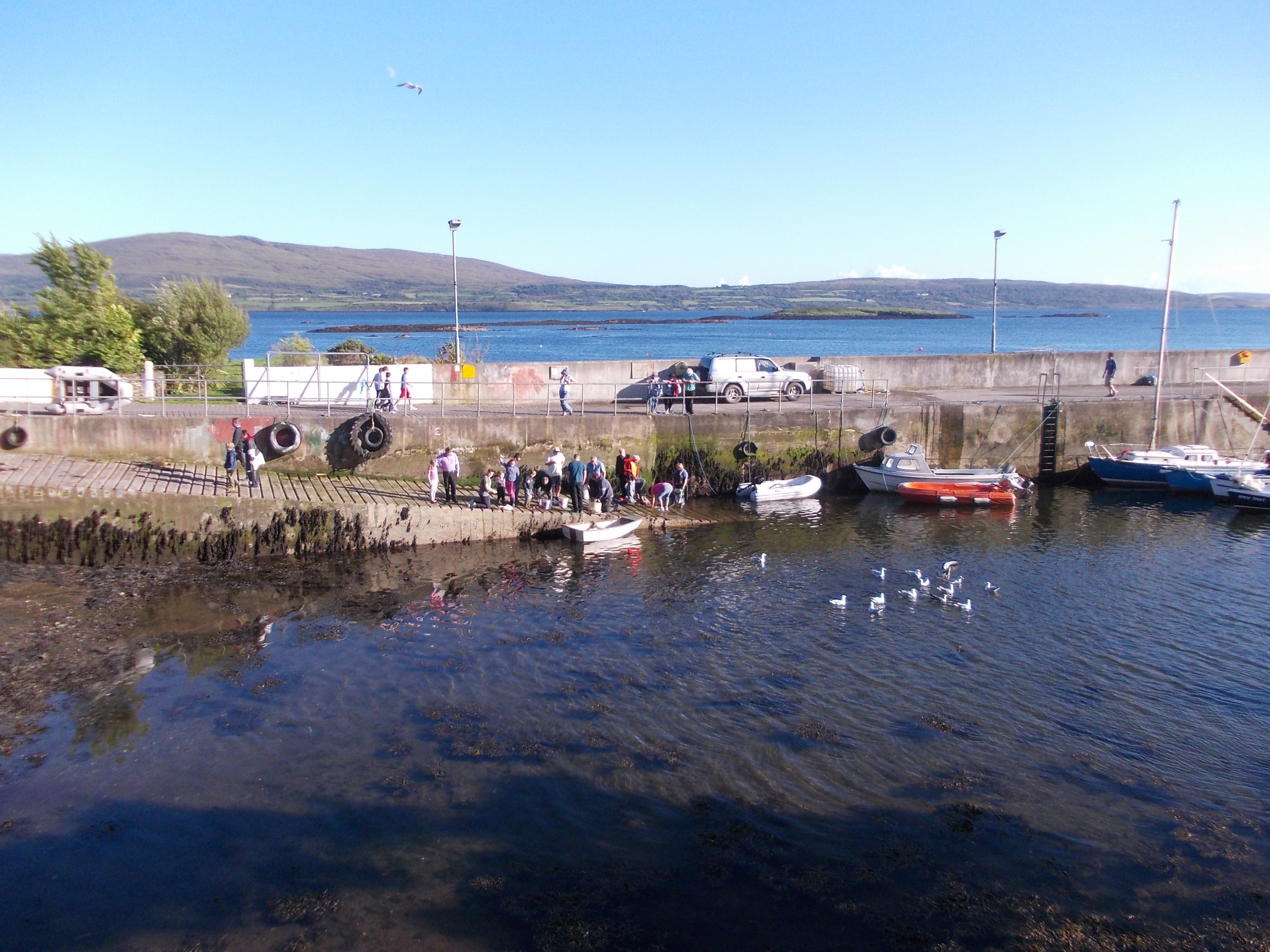
The brook curved down over the rocks, innocent and white, until it faced a little strand of smooth gravel and flat stones. It turned then to the left, and thereafter its guilty current was tinged with the pink of diluted blood. Boulders standing neck-deep in the water were rimmed with red; they wore bloody collars whose tops marked the supreme instant of some tragic movement of the stream. In the pale green shallows of the bay’s edge, the outward flow from the criminal little brook was as eloquently marked as if a long crimson carpet had been laid upon the waters. The scene of the carnage was the strand of smooth gravel and flat stones, and the fruit of the carnage was cleaned mackerel.

The donkey with his cart-load of gleaming fish, and escorted by the whooping and laughing boys, galloped along the quay and up a street of the village until he was turned off at the gravelly strand, at the point where the colour of the brook was changing. Here twenty people of both sexes and all ages were preparing the fish for market. The mackerel, beautiful as fire-etched salvers, first were passed to a long table, around which worked as many women as could have elbow room. Each one could clean a fish with two motions of the knife. Then the washers, men who stood over the troughs filled with running water from the brook, soused the fish until the outlet became a sinister element that in an instant changed the brook from a happy thing of gorse and heather of the hills to an evil stream, sullen and reddened. After being washed, the fish were carried to a group of girls with knives, who made the cuts that enabled each fish to flatten out in the manner known of the breakfast table. And after the girls came the men and boys, who rubbed each fish thoroughly with great handfuls of coarse salt, which was whiter than snow, and shone in the daylight from a multitude of gleaming points, diamond-like. Last came the packers, drilled in the art of getting neither too few nor too many mackerel into a barrel, sprinkling constantly prodigal layers of brilliant salt. There were many intermediate corps of boys and girls carrying fish from point to point, and sometimes building them in stacks convenient to the hands of the more important labourers.

On the top of the pier the figure of the melancholy old man was portrayed upon the polished water. He was still dangling his line hopelessly. He gazed down into the misty water. Once he stirred and murmured: “Bad luck to thim.” Otherwise he seemed to remain motionless for hours. One by one the fishing-boats floated away. The brook changed its colour, and in the dusk showed a tumble of pearly white among the rocks.

A cold night wind, sweeping transversely across the pier, awakened perhaps the rheumatism in the old man’s bones. He arose and, mumbling and grumbling, began to wind his line. The waves were lashing the stones. He moved off towards the intense darkness of the village streets.

A first afternoon at The Cottage

That first day I went out in Jolly Roger with Galen and caught three mackerel. We lost the first one. As I grabbed at the fish my hand caught around the orange nylon line and as I tried to untangle it without getting caught on a hook the fish arched and fell back in the water. Maybe this was some part of getting used to be being back, another hour or so I would have been more firm,  less concerned by a scratch from a hook, and more concerned with getting the mackerel into the bucket.

Galen had wanted to kill the fish that we managed to keep in the boat and as I held the it still so he could deliver the blow the priest caught my finger. The first ‘buggeration’ of the summer!

We filleted the other two and ate them around the fire on the beach. The fillets thrown into a frying pan for a few minutes and then chopped into two, garnished with chopped fennel from the pier patch and put on plate and eaten with our fingers.

---_0189

J.G. Farrell on the Sheep’s Head

That morning we had been for a walk up by Gortavellig and the abandoned copper mines and before that past the old slipway. The sea had been quiet and the children walked down the slope to the water running back up as the waves came in.

DSCN1000

I was back in the pub now for a pint in the late afternoon. There was a man there and I had asked him about the story I’d heard of an old style film producer who had lived in the house on the corner where the road turns left to Kilcrohane and right to Durrus on straight road through the hills and there is a bridge over Ahakista Stream.

‘That was Wolf Mankowitz’ he said. ‘He had the house and he died there as well, too much time spent in this pub my Dad said. He was a friend briefly of Jim Farrell. Did you hear of the writer J.G. Farrell. We knew him as Jim.’

Up by the slipway we had seen the bronze plaque with him name on and a list of his books. It had sent me down to call at the children to come back from the water.

‘Did you know him?’ I asked.

‘I was a boy then so I can’t say that I knew him but I met him a few times and he would drink in the pub in Kilcrohane a few times before he died. Kilcrohane’s not too much of a walk on the straight road and he would walk down too from his house. He lived up in Letter beyond the Alice West House, Black Gate. So I shook his hand with my Dad and we passed a few words. But knowing him?’

‘Well I think that if there is a man whose a writer and he’s lived for a while where you live then you should read some his writing to get a fix in your mind on his. After he died there were times I came across his books in Bantry Market. You go there enough times on a Friday there’s a whole library of books you can pick up and so I did over time. I read his books and I got a fix on his mind. But did I know him? I don’t know that.’

‘One of his books is about a hotel in Ireland and it’s burnt down and all there is left is the ruins and the melted glass and and the cracked remains of the baths, sinks and toilets. I always had in mind that he was writing about one of those smart hotels in Glengariff. One of those places where Queen Victoria might have stayed. But it was someplace over in New York where he wrote that he was thinking about. I felt disappointed when I found that out.’

‘There is something restless about the books that I read. He was moving around and trying to settle down into the words that he wanted to put on the page and he couldn’t quite do it but I read he was happy here.’

‘There was a book of his letters for sale in the Cafe on the road into Durrus. I did some work there last summer mending broken windows and when it was quiet I picked the book from the shelf and had a look. It was too expensive to buy but I wanted to read what he said about this place.’

‘It was sad. There you had a book of 500 pages and only 25 were from here and he seemed to be happy and then he died. He had dinner at the house on the corner with Wolfie and he made friends with Curly. That must have been Curly O’Brien. But what made him happiest was catching fish.’

‘I remember now he would be there in the pub and he would have brought with him a bagful of mackerel. Four of them and he’d lay them out on the bar so we could see what he’d caught and it was if he had never caught fish before. This was 1979 and there wasn’t mush transport so I think that the fish that he caught was good food. He’d try to grown some things in his garden but the soil there was bad and whatever came up green was soon eaten so those fish would have been good. He was surprised with what you can catch from a rock with a line.’

‘That was the year that the Fasnet race got blown out. Wolf he had a big party and there were a hundred boats down there in bay all his friends come for the party and it all got blown out by the wind. The writer he was fishing from his rock. he’d gone there to get some pollock and with the weather I don’t know he had heavy clothes on and a wave came in and he was in the water and gone. There was a woman, she saw him fall, and she said that once he was in that was it and he ever came up again.’

‘It was six weeks later he washed up again on the other side of the bay. but I think he was happy, he thought that the fishing was a bliss.’

My book is at last making little progress though it has a rival now – viz. fishing off the rocks. I know no one is going to believe me but I’ve actually been catching fish and eating them, great fun and beats writing into a cocked hat.

 A Thursday in June 1979


Seine net fishing from Kilcrohane

242

There are a number of books around the Cottage that tell of live on the Sheep’s Head and around West Cork and give some of the history of the place. This is an extract from one of those books Under the Shadow of Suifinn by Ann McCarthy.

My great grandfather had a Mackerel Seine which was made of cotton and was 180 fathoms long, and 18 fathoms deep at the bunt (the widest part). The seine was tapered at the sleeves (the narrow ends). At the bottom there was a row of lead rings, and the trip rope went through these. When it was wet, it took seven men to lift it to a field to be spread out, so it could be repaired. It had to be barked (dyed and treated) in a big pot that holds 120 gallons.

The net was stored in the room that I sleep in now. There used to by a hinged window to take it in and out. It was not uncommon to catch 6,000 fish in the seine at a time. The seine was transported in a seine boat, which was 27 feet long and 7 feet wide. It was rowed by six men, with a captain on the back at the tiller. In the stern was the man who watched for fish, and he also used the “thrash block” which was a rope tied to a stone and was used for directing fish into the seine.

The seine boat was accompanied by the “falter” which was crewed by four men. It was they who took the end of the seine from the seine boat when they saw a shoal of fish, and shot the seine around them. Then they helped to bail the fish which were floating on the surface into both boats. While they were waiting for the shoal to rise, they always said the Rosary. It was not uncommon to spend 12 hours during the night without finding a shoal. As Wellingtons and oilskins were unheard of the men often suffered from the wet. Their lamp was worked on fish oil and cotton wick, which was also used to light their pipes.

As there was no pier, the loaded boats had to be anchored a safe distance from the rocky beach. The crews unloaded the boats wading through three or four feet of water. The baskets of fish were put on large tables and the splitters and gutters cleaned them. Schoolboys took them to the river and washed them, after which they were brought back to the tables and packed in barrels of coarse salt. Approximately 120 big fish filled a barrel. Six months later a ship would come and the small boats would take the barrels out to the ship, which was anchored in the bay. The ship had a canhook (winch) which took three barrels at a time. the ships’ names were “Mary Audrey” and the “Princess Beara”. the fish was taken to North America. in a good season a fisherman would earn £70, the price for a barrel of fish being £1.7.6

A storm in 1940, which wrecked the boats and knocked the storing shed, finished this industry, with the help of the collapse of the American market.

Helen O’Mahony, Lower Letter, 6th Grade Kilcrohane National School 29-6-88 Under the Shadow of Suifinn

O’Mahony is one of the local names and it is the name of the shop in Kilcrohane.

244