Untitled events

Last week the first daffodils were out and this Saturday morning I have been down to end of the garden were we have a small pond that has been mostly taken over by reeds. Somehow a couple of goldfish have managed to survive in there for the last four or five years but I couldn’t see them this morning. Instead there was a large bulbous mass of frog spawn. Good to see that at least one of the frogs we had in the garden last year has been able to survive the cats.

Almost directly opposite the kitchen window there is a stone wall that is about eight feet tall. It is crumbling around the edges and every year I have to cut back the buddleia which seems able to penetrate every spare crack. There is an hole in the wall and over the last few days a couple of blue tits have been eyeing it up. It is just about out of reach of the cats although one year a cat did manage to position itself on the top of the wall directly above the hole and it came within a flick of its claw to putting to an end that years family until a sharp stone sent it on its way.

A walk to the west

If I have the need to go west then a walk to the end of the pier will do it.

The pier runs from the back of the Cottage.

Opposite the Butter House there is a splay of concrete from the road, a slipway that runs down at a steep slippy slope into the water, and then the pier, about 300 yards long, jutting out into Kitchen Cove and running west on a line parrellel to the back-bone of the peninsula as it heads off into the Atlantic and Dunmannus Bay as it narrows inland and the soft Cork countryside closes in on it until it peters out in Durrus.

The walk from the door of the Cottage to end end of the pier should take no more than one and half, maybe two minutes, but invariably more time is needed to take in stops along the way. A pause to look up the road towards the pub, time to put your hand against the metal railing that for part of the way stops you from falling into the water, to look at which boats are there, to take in the gulls stood on the top of which lamp-post, the reflection of trees in the water and the weather.

How much of your life could you allow to be spent in those few minutes and having got to the end where else would you want to go?DSCN1658

Pumpernickel and smelly feet

To my surprise I have not been able to find much that has been written on pumpernickel. I half thought that Elizabeth David would have a few good paragraphs in her book on bread cookery or that there would be a section devoted to it in Alan Davidson’s  Oxford Companion to Food. But there was nothing to be found.

Then I remembered that the Wikipedia article I found explaining the relationship between pumpernickel and flatulence also made reference to the Dutch version of the bread roggebrood. I have a book on Dutch baking called Windmills in my oven and in it there is a whole three pages on roggebrood. 

The book sets out to uncover the hidden history and tradition of Dutch baking and expose it to the world in all its glory – so there are chapters on pancakes and speculass, stroopwafels and a type of Dutch sweet coiled sugared bread that goes by the nickname of droppen on account of its unfortunate but unmistakable resemblance to a turd.

The section on roggebrood explains that for many people then it was seen as only being fit for feeding to livestock and that sometimes the quality of rye was so poor that it brought on a case of sand colic to anyone who tried to eat it.

It goes on to explain how the dough would be kneaded in great wooden troughs, though ‘treaded’ would be a better more accurate. The first dough-kneader was invented in 1603, expressly for avoiding foot contact and thereby rendering it more palatable in the inventor’s view, but it wasn’t until the beginning of the twentieth century that machines -dog, horse and petrol driven – gained popularity, especially in rural areas. Using feet was the easiest way to knead the heavy dough efficiently, making full use of one’s weight. The modern mind finds this distasteful; not so the customers of old. As one former baker recounts, a customer complained at the beginning that the bread had a machine taste, whereupon the baker tartly rejoined that at least the sweaty foot aroma was gone. Admittedly, both body temperature and physical contact have a beneficial effect on dough…..

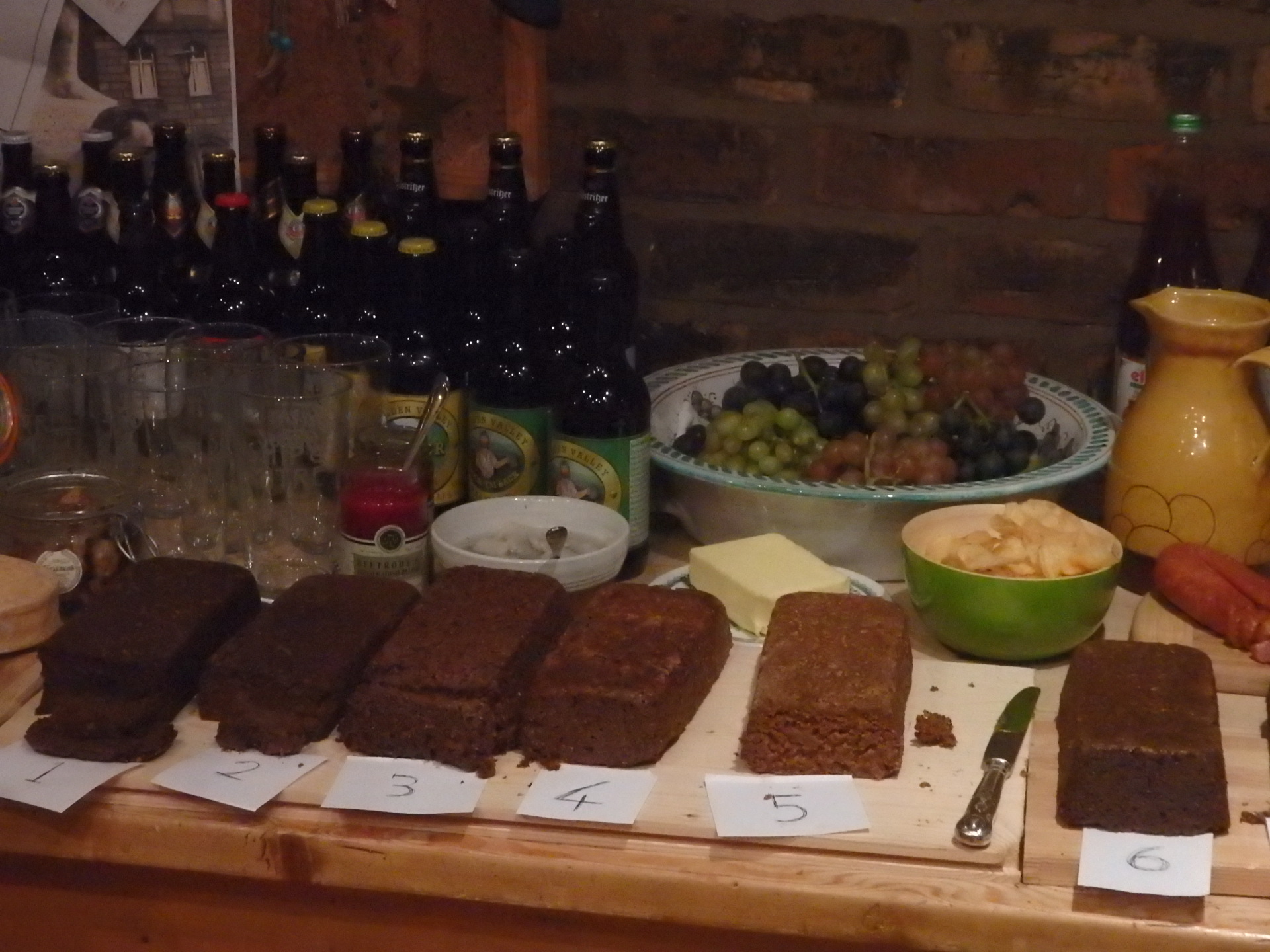
Which all perhaps begs the question as to which of the seven were treaded as opposed to kneaded?

OLYMPUS DIGITAL CAMERA

Pumpernickel – a gathering of old farts!

We ate pumpernickel last night and one or two questions were asked as to the meaning of the word.

So when in doubt turn to Wikipedia!

The philologist Johann Christoph Adelung states that the word has an origin in the Germanic vernacular where pumpern was a New High German synonym for being flatulent, and Nickel was a form of the name Nicholas, commonly associated with a goblin or devil (e.g. “Old Nick”, a familiar name for Satan), or more generally for a malevolent spirit or demon. Hence, pumpernickel is described as the “devil’s fart”, a definition accepted by the Stopes International Language Database, the publisher Random House, and by some English language dictionaries, including the Merriam-Webster Dictionary. The American Heritage Dictionary adds “so named from being hard to digest”. A variant of this explanation is also given by the German etymological dictionary “Kluge” that says the word pumpernickel is older than its usage for the particular type of bread, and may have been used as a mocking name for a person of unrefined manners (“farting nick”) first. The change of meaning may have been caused by its use as a mocking expression for the (in the eyes of outsiders) unrefined rye bread produced by the Westphalian population.

The OED does not commit to any particular etymology for the word. It suggests it may mean a lout or booby, but also says “origin uncertain”. The OED currently states the first use in English was in 1756.

A false folk etymology involves Napoleon, who, while invading Germany, asked for bread and was served dark Westphalian rye bread. According to the folktale, Napoleon declared that this was not suitable bread for himself, the emperor, but was bread (pain) for Nickel (or Nicole), his horse: “C’est du pain pour Nickel/Nicole!” In a variation of the same basic story, Napoleon declared that the bread was no good for him, but was only good (bon) for his horse: “C’est bon pour Nickel!” The name “Nickel” is not confirmed for any of Napoleon’s many horses, still, given the number of horses used, this remains a possibility. This folk etymology grew from a “witty interpretation”, proposed by seventeenth-century satirist  Johann Balthasar Schupp, that the bread was only good for “Nicol”, a nickname for a weak or puny horse. It is not clear why anyone imagines that the Germans would name a much loved local speciality after an insult in a language they did not understand.
OLYMPUS DIGITAL CAMERA

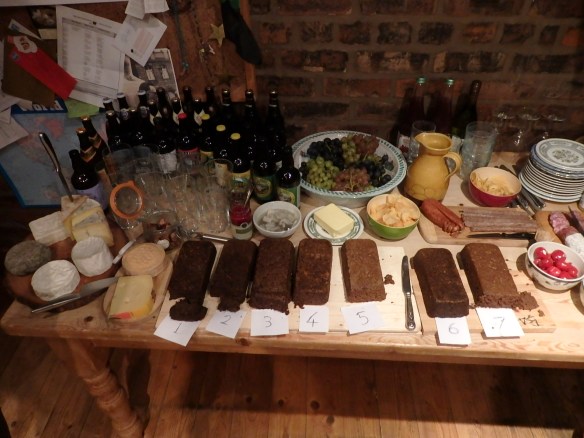
Is there a word to describe a gathering of pumpernickels? Would trump cover it?

Anyway they were mighty fine. As was the beer, cheese and sausage.