Welsh Rarebit

One of the staples on the menu at school was Welsh Rarebit except they called it Welsh Rabbit the words spelt out in white letters on the black board over the queue for trays and then food. Even then I wondered where was the rabbit and why was it Welsh.

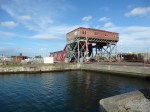
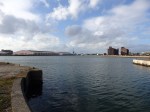
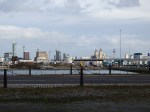
This morning I took a drive round some of the backwaters of Birkenhead. Unfortunately the camera ran out of battery. I will be back.

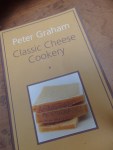
Last week in Oxford I picked up in the second hand section in Blackwell’s a second hand copy of a book on cooking with cheese. It sold itself to me as it had half a dozen pages devoted to Welsh Rabbit/Rarebit including a couple on which name was right and why it was Welsh, It transpires that no-one really knows.

We had it for lunch today although I didn’t follow any of the recipes in the book.

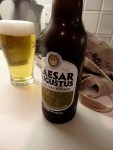
A good lump of mature cheddar was grated into a bowl. I stirred into it some mustard, a squashed clove of garlic and enough light bitter to turn it into a sludge.

Bread was toasted under the grill and the cheesy mixture smeared on top and then put back under the grill until it browned and bubbled.

One or two heretics put a piece of ham on their toast before covering it with the cheesy mixture.

We ate it listening to Perfume Genius. The families favourite music for the weekend.

I already had a copy of the book!

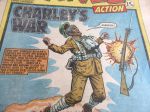
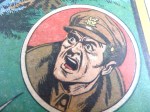
Charley’s War

Forty or so years ago I used to read a comic called Battle. It was a proper comic on thin floppy paper. It came out once a week and there were half a dozen or so stories in it all about war. There were a number of other similar comics one of which was called Victor. But Battle was the best. The stories had more grit about them. Men died untidy deaths. There was an ongoing story about Johnny Red – a disgraced Spitfire pilot who found himself flying for the Russians; Blackie’ War  -about a lost sergeant who fought a particularly violent and bloody war in the jungles of the Far East, and Charley’s War, the ongoing story of a young private in the trenches of the First World War.

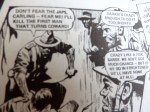
Over the last ten years the strips that made up Charley’s War have been republished in book form. A new edition has come out in October time and they have become a regular Christmas present. The stories were written by Pat Mills and drawn by Joe Colquoun and over the ten volumes build up in to a vivid history of the war. There are diversions into life in the navy and some of the experiences of the French Army, the mining that took place under the trenches (years before Songbird) and the near mutinies that took place in the British Army. A lot of the stories centre around the contrasting exeriences of the men and the officeresThere is no soft-soaping. Men, friends, die violent, horrible deaths. One story ends with Charlie have to collect the remains of his friend Ginger into a bag.

Driving home early from work on Friday I found myself listening to Radio 4 and an ongoing series on voices from The First World War. There were three r four men talking about their experiences fighting in the trenches. They must have been recorded more than fifty years ago but they sounded as fresh and as clear live on the radio and in their talk they brought back to mind stories in Charley’s War which must be a testament to how closely they got it right in the comic.

A room with a view

I moved office today and after eight years I now have a room with a view.

Up until now every desk I have sat at in the building has been next to a window but the glass has been inward looking into a large glass atrium meaning that the only view was a set of offices exactly like mine but with less paper and mess.

Now I have moved ten yards across the way and the window next to my desk looks out over fresh air. If I look over my shoulder I can a hundred yard stretch of The River Mersey, enough to be able to watch the boats and some ships come in then go out again, up a bit from there I can see the docks of Birkenhead and up from that, on the horizon, the trees of Oxton and St Saviour’s Church. Somewhere to the right of the church and hidden amongst the trees is home.

On a good day I will be able to see the hills of Wales and on a evening as the sun goes down the sky may light up a bright pink like it did last week. All from my desk.

It is just a pity it isn’t a view of Dunmannus Bay!

235

Ras el Hanout and Ai Weiwei

The weekend was spent in Oxford so Saturday morning we made another trip down Cowley Road.

This time I was determined on buying the ingredients for a meal that evening. There are at least two good Middle-Eastern food shops on the road and I am now a regular visitor so as to make sure there is a good stock of Moghrabieh or Giant Couscous in the house.

The intention was that I buy myself a packet of Ras el Hanout and use this to flavour some chicken. Ras el Hanout is a Middle-Eastern spice that is made up of a blend of different spices such as cumin and fenugreek. Each shop that sells it is supposed to have their own particular blend some of which are better than others. I was expecting to be able to buy a nice neat packet of it.

In the event the Ras el Hanout was difficult to find. I thought it would be there sitting proudly amongst the other clear bags of spices, the dried limes and barberries, the sumac and rose petal leaves, but at first glance it was nowhere to be seen. However after digging around I found some packets tucked in a corner hidden away behind some bags of rice.

Back at the house I worked through how to cook with it.

I should have started by rubbing the Ras el Hanout into some pieces of chicken and allowing it to marinade for an hour or so. But people were hungary and there wasn’t time.

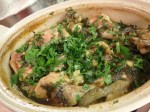
So I started with a mixture of chicken thighs and legs that were fried in hot oil until they started to hiss and spit and stick to the bottom of the pan. As they cooked I seasoned them with salt and pepper and a good dose of the Ras el Hanout.

Once the chicken was browned I removed to a bowl and then cooked some thickly sliced onions, a mixture of thickly sliced red, white and spring onions, with more oil in the pan in which the chicken had been cooking. Once the onions were soft I added some garlic and then stirred the chicken back in together with a cup of water. It was brought up to a simmer and then left to cook through.

When it was done I stirred in some chopped parsley.

We ate it with Moghrabieh, aubergine with onion, carrots cooked with cumin and honey and warmed flat bread.

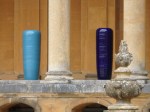
Sunday we made a trip to Blenheim Palace. This was mostly see the exhibition of art by Ai Weiwei that was spread around the house and grounds. There were about thirty pieces in all some of them so big and imposing thy couldn’t be missed, such as the twenty foot chandelier hung from the ceiling of the great entrance hall, but others were hidden away amongst whatever else was there and could have been easily mistaken for something that had been left behind, such as a plaster helmut, or a set of china plates in a room full of china. There was a leaflet identifying the pieces and you could, if you wanted, tick them off as you walked around.

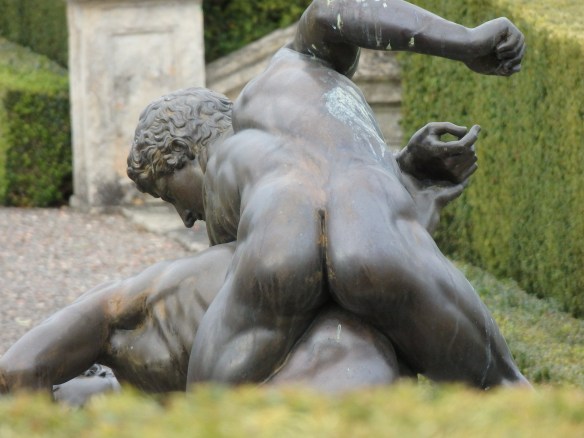
But perhaps the most arresting sight there as nothing to do with Ai Weiwei but was a bronze statue in the gardens of two men wresting. See what you make of it.
OLYMPUS DIGITAL CAMERA