Eating the Gurnard


DSCN3428

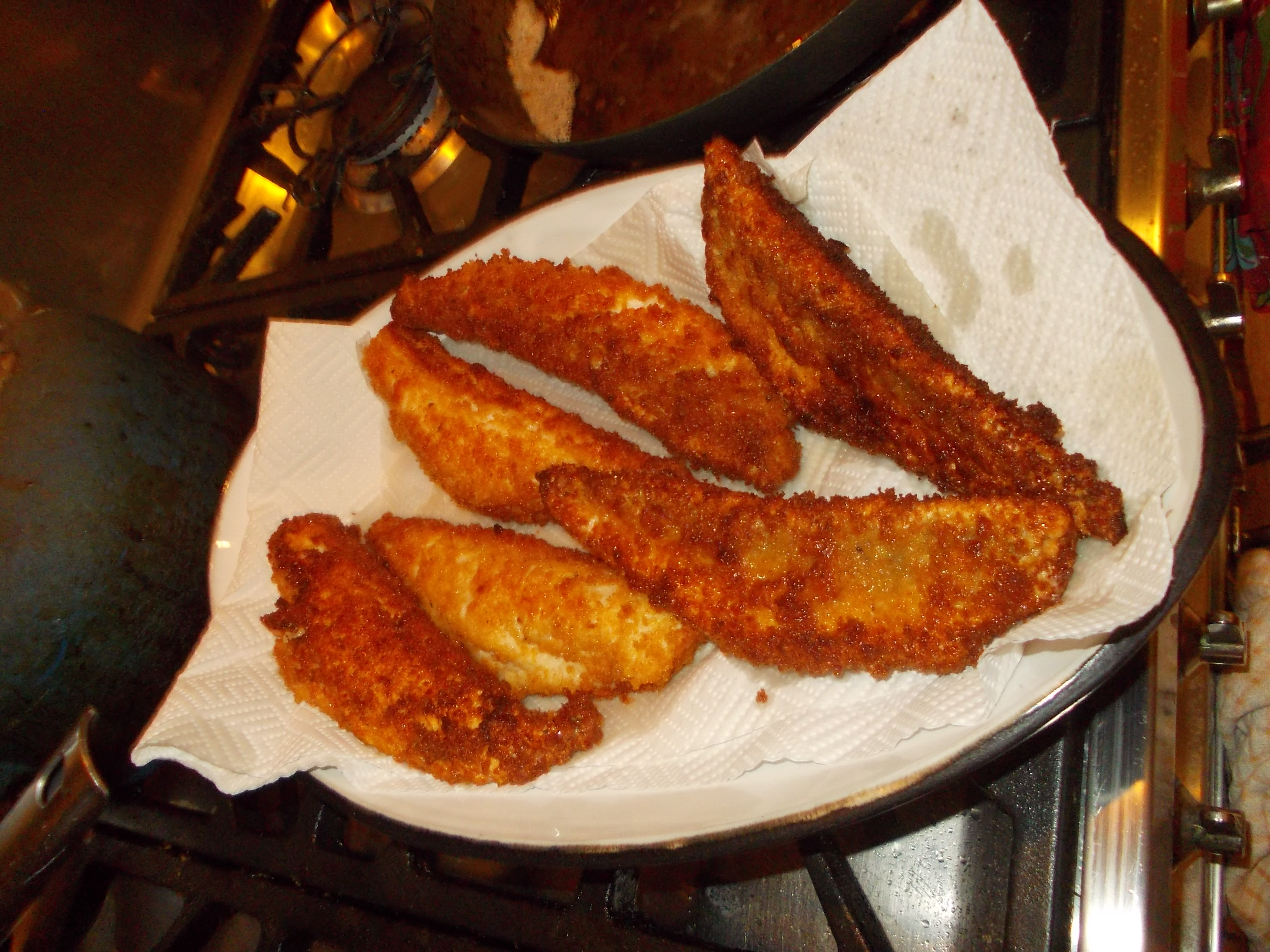
We have eaten the gurnard and it was good. The fillets coated with flour, egg and breadcrumbs and then deep fried. We ate them with roast potatoes and garlic, peas and tartare sauce. Shortly before cooking I had to shoot out to the shops again to buy more Heinz Tomato Ketchup. I think there is a race in the house to see what we get through more quickly – ketchup or olive oil.

DSCN3427

The house is now quiet. One child has gone out, leaving the house with a friend clutching a bottle of Lambrini. Another child is mooching round the house having been out all day and told to be in for the evening. The odd door is being slammed but the child is keeping out of the way. The last child claims to be doing homework whilst watching television.

The biggest child is sat doing this listening to Neu!

During the course of the morning shop round Birkenhead I slipped into HMV for a few minutes. The shop in The Grange Precinct is always fairly depressing but this felt more so. The was a clearance house air about the place and the diminishing music all up for sale. that didn’t stop me buying and I came away with four CDs I probably did not need.

But the CDs included the last Husker Du album Warehouse:Songs and Stories. Now I may have said this before (its up there with my top ten lessons on rock’n’roll – along with don’t change your guitar during a gig) but there is a good argument that once Husker Du laid down their guitars and drum kit that was it for rock and roll. After them we have only been dealing with pale imitations, boys and girls, just repeating the same old pose.

Warehouse:Song and Stories wasn’t their best album but it finishes with one of those songs in which the whole noise that is made by drums and young men hitting guitars very hard mesh into some sort of glorious whole. There was a lot going on in the band at the time. Two gay men who may or may not have been in a relationship and now hated each other, drugs and a bass player with a great moustache who wanted to be a chef.

The song, You can live at home, has as its coda the words keep walking away which are howled out by drummer Grant Hart as Bob Mould seems to take hold everyof  guitar there was in the studio and beat the living daylights out of it. It is a great corruscating painful noise and after it had finished all they could do was walk away from each other without being able to do anything quite as good later.

Years after it came out we went to see a band called Zu Zu’s Petals play in a hall in Reading. It was only when we got there we realised they were supporting Nova Mob, the band Grant Hart formed after Husker Du fell apart. They were brilliant.

The Sea Robin

DSCN2095

Gurnard is a forgotten fish. You might sometimes see it on a fishmongers slab but it is not a fish that you would go out of your way to buy. But you should. It is one those ugly fish that are full of flavour and make a good stock. I suspect people are put off by its heavy hard head which could almost be a small piece of armour. It is of course that head that gives the flavour to stock.

http://www.goodfishguide.co.uk/fish/gurnard-red-156

They were given a brief mention in the stories about mackerel last week having also been downgraded by the Marine Conservation Society. No-one goes out to catch Gurnard. A fisherman might keep them if they are big enough when they come up in the net otherwise they get discarded. Discarding is the fate of a lot of them and because they are not that important no-one really knows how many there are and what damage we are doing to their population.

http://www.goodfishguide.co.uk/fish/gurnard-red-156

They are also known as The Sea Robin. They live at the bottom of the sea rooting around for food in the sand 200 yards under the surface. In the water their large pectoral fins open and shut like a bird in flight. By these fins they have three spines which they use to ‘walk’ on the bottom. Although it may look like they are walking the spines stir up the sand and disturb their food.

The name gurnard comes from the sound they make when pulled out of the sea. They have a drumming muscle which beats out a sound a bit like a frog’s croak.

They had some in Wards this morning so I bought three. They were filleted and we will have them this evening deep fried in breadcrumbs with potatoes and peas. I brought the bones back with me to make some stock.

At the counter Nigel, Simon and I talked about mackerel. They had some big ones on the ice. Too big for me but bright still and with their colour unlike the sad wrinkled ones in the supermarket. A customer had been in that week, she had been listening to the news, and would not b buying them again. It was the great factory ships taking them up, hoovering them out of the sea, to be frozen and taken to Spain, where all the good fish go.


Sausages and lentils

It is thick wet snow outside. The kind of weather that makes you feel you would rather not go outside again. Hopefully it will be gone tomorrow. I had been hoping it would be dry over the weekend and there would be time in the garden for a fire in the corner but whatever happens with the snow it will be too damp and the fire will have to wait until next week.

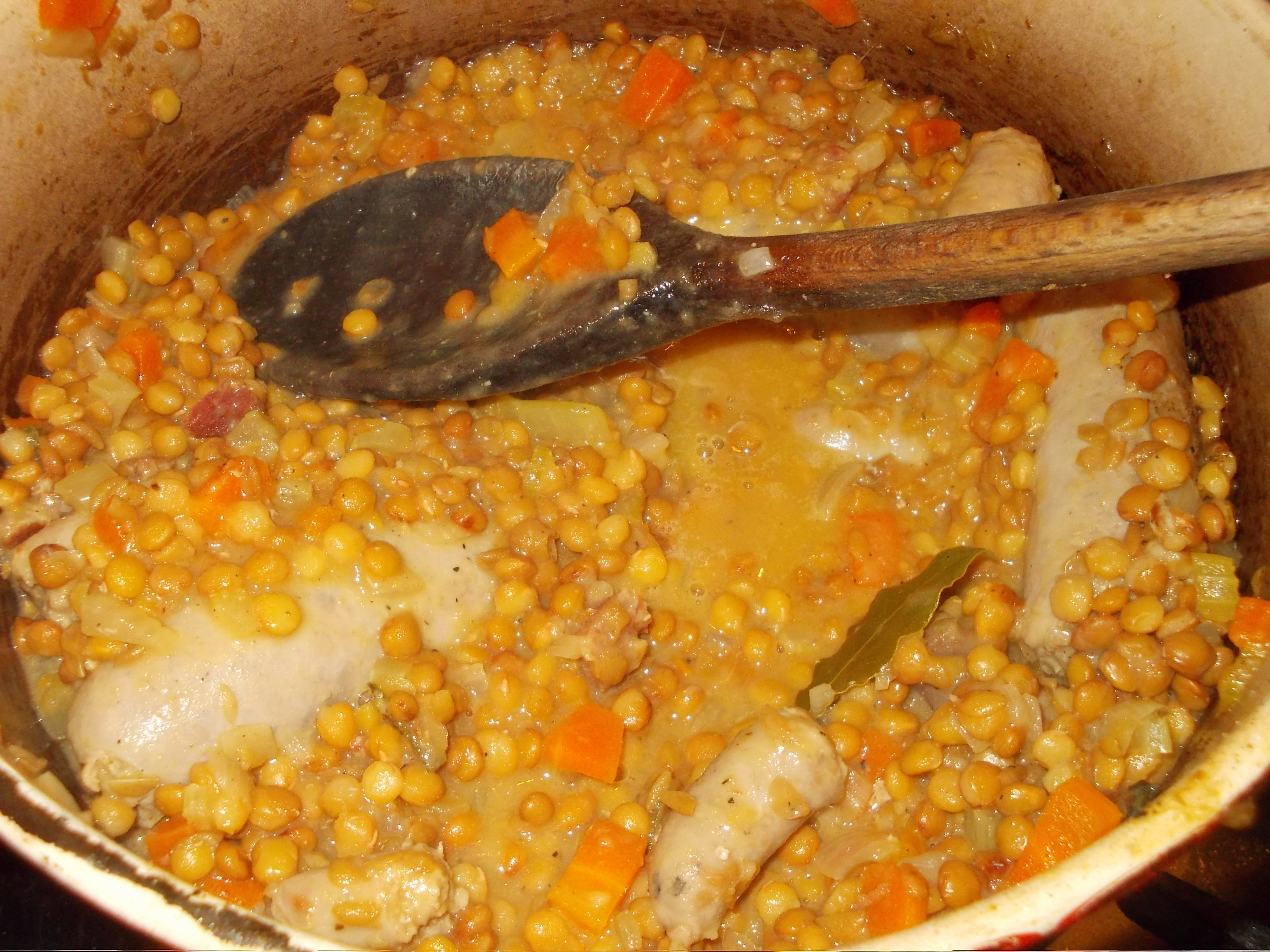
Last night Galen and I had a frugal supper. A pack of six sausages cooked in a pot together the tightly chopped ends of some chorizo I found lurking in the back of the fridge. I had to scrape bits of mould off but I figured that would add to the flavour.

Once the sausages had started to brown I added a chopped onion, some celery and then a finely chopped carrot. That was all left to stew in its fat for a while. I scurried down to the basement to find some cider. I knew I had seen a bottle lurking in a corner, French, use by date about five years ago. I think it must have come back from Normandy. The cork came off with a satisfying pop and I poured some into a glass. I tasted it expecting vinegar but came up with a mouthful of dry apples. A good glass of that went over the sausages and I poured a glass out for myself.

Over lunch I had been to Lunya and bought a jar El Navarrico lentils. Whilst getting them precooked is cheating and more expensive they are worth it. They have a dense earthy flavour and just the right bite. There also make a good glupping sound as you shake the jar to get the lentils into the pan.

DSCN3423

We ate the sausages and lentils with the rest of the cider.

DSCN3425

A good Thurday night meal.

A mackerel sky


DSCN1277

Driving to work this morning and Mr. Steingrímur J. Sigfússon Iceland’s Minister of Industries and Innovation is on The Today programme being interviewed by Sarah Montague. He was there to answer the charge that Icelandic (and Faroese) fishermen are performing a mugging job. It was not clear whether it was the mackerel or Scottish fishermen (who had used the phase) who were being mugged.

He made it all sound very unfair and basically it was the mackerel’s fault. As a result of climate change they had followed their noses to where the food was and unfortunately this was within the waters of Iceland and the Faroe islands. The mackerel were ‘grazing’ in these foreign waters and having the temerity to eat the fish that the local fishermen would otherwise be catching. This was putting out the biomass and although he didn’t quite say it the suggestion was that they were going to have to haul ever greater quantities out of the water until the balance was put right.

Reassuringly he told us that they calculated that there is now approximately 1.5 million tonnes of mackerel within the Icelandic waters. These make up some 25-30% of the entire mackerel stock. Doing some very rough calculations and on the basis that an average sized mackerel weighs about 500g that is roughly 2,000 mackerel per tonne, a total of some 3,000,000,000 which I think is about 3 billion. That of course is an awful lot of fish. But then look at a picture like this and bear in mind the technology that allows the boats to pinpoint the vast dark shoals in the water so that they can lay their nets around them.

Purse Seine Nets

There is a press release on the Minister’s website in which he says: ‘Not only are mackerel rapidly increasing in number, but they are growing in weight as well. Individual mackerel gain an estimated 43-55 percent in weight while in Icelandic waters, meaning a huge increase in the amount each fish consumes.’

Towards the end of the interview he complained that by feeding in Icelandic waters the mackerel were getting a ‘free lunch’.
Now I can’t claim to be any sort of expert and I certainly don’t know enough to be sure o who is right and who is wrong in the arguement. But to be blaming the mackerel seems a little unfair. If we were talking about cattle and a farmer who was letting his cows feed in his neighbours field you might be able to see why the neighbour would get aggrieved. But the mackerel have no choice where to go and to start on a process whereby you end up putting at risk their sustainability seems stupid and wrong.
So I put myself back in the pub, stood next to the man with the black beard both nursing our pints. I ask him question: ‘Do you think there’ll come a year when the mackerel don’t come back in the Spring.’
He doesn’t answer but takes another sip at his pint. We both look out through the window over the great bulk of water that is Dunmannus Bay. Here it is about half a mile wide, further up by the heads it is five miles across from The Sheep’s Head to The Mizen.
‘If the mackerel are gone then we’re all gone. Look at that water out there. I hear now there are nets that would stretch across the bay and they’d drag up every feckin’ fish in there. Well they can have them but if they’re gone they won’t come back and once the fish are gone then it would be quiet here. We’d be down eating the seaweed and limpets and they’d make you sick and soon there’d be nothing left. The feckin’ idiots they need to leave alone.’
There was an anger in his voice then and he turned away to look over the bar. ‘Mary,’ he calls, ‘Mary this idiot thinks they’re going to be catching all the mackerel so there is feck all of them left. Mary take this note here and put it behind that bottle there and make sure he gets a good pint when the mackerel are gone for good.’ He passes over a note and Mary tucks it behind the till.
‘Look at the sky now it is a mackerel sky. See how the clouds are lined up and the blue behind is like those black marks over a mackerels back. You get rid of the fish you can rub out the sky and that will be it.’ He tips up his pint and drinks to the fish. I join him and the back out in the bay a mass of mackerel churns on the blues silver and green turning ever on chasing sprats.